


Spend enough time in-clinic, and you’ll encounter two very different patients with ocular surface disease (OSD). The first has used artificial tears for years. Her eyes feel “fine,” she says, yet fluorescein staining lights up her cornea. The second is miserable, with burning, grittiness, and blurry vision by mid-afternoon, even though her ocular surface looks nearly pristine. Both have OSD, but neither fits the textbook presentation.
That’s everyday OSD: one of the most common reasons patients seek eyecare, and one of the hardest conditions to manage well.1 Signs and symptoms often don't align, and most patients have more than one issue going on.2
As a student, you’ll see patients like these on every rotation. Learning to manage them well starts with understanding why OSD behaves as it does—and which tools are now available to treat it.
The good news is that the TFOS DEWS III reports provide a clearer diagnostic framework, and clinicians now have a genuinely new set of tools to match.3,4 Here's what's changed and how optometrists are putting it to work.
Why OSD stays hard
Most chronic diseases get worse in ways you can see, and the patient can feel. OSD often doesn't. For example, as dry eye disease (DED) progresses, symptoms may initially worsen but then diminish as corneal nerves downregulate.5 A patient with severe staining may report fewer symptoms than one with moderate disease, and this disconnect can mislead clinicians who rely equally on symptoms and clinical evidence.
That mismatch is common, not the exception. In a secondary analysis of the DREAM study, symptom–sign discordance was widespread and persisted over time.6
The multifactorial nature of OSD complicates its management. A single patient may have aqueous deficiency, evaporative meibomian gland dysfunction (MGD), inflammation, neurosensory changes, environmental triggers, medication effects, and lid or blink problems, sometimes all at once. Several masquerading conditions mimic dry eye and won't improve if you treat only dry eye.7
The answer is a consistent framework: structured screening, focused testing, and a clear escalation plan.
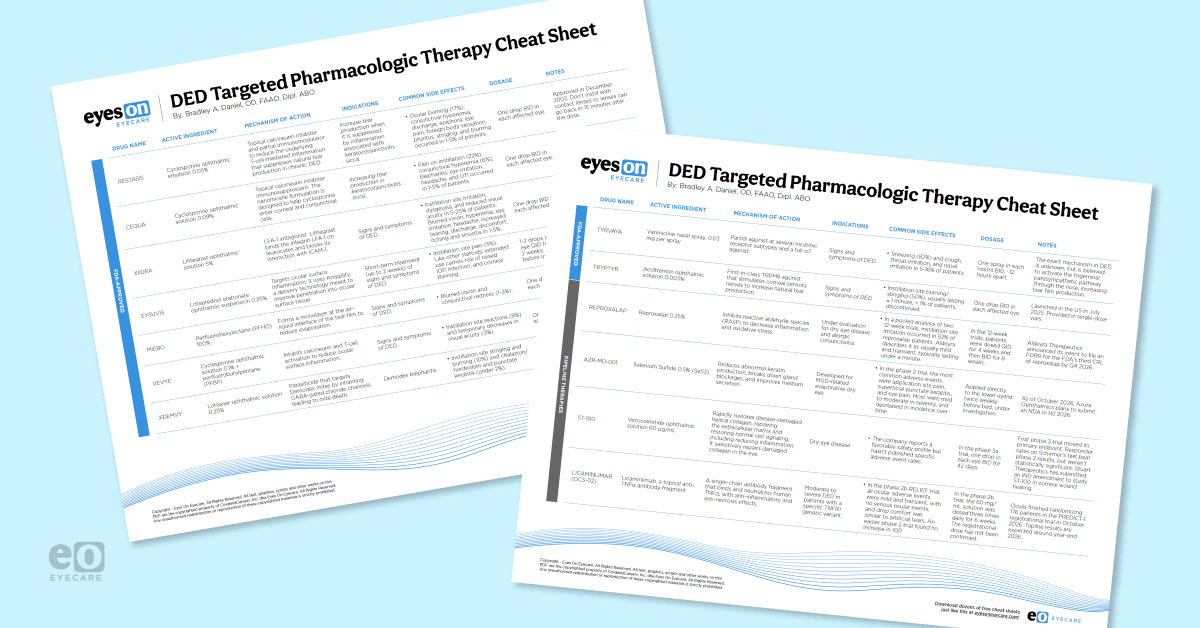
Download the cheat sheet here!

DED Targeted Pharmacologic Therapy Cheat Sheet
Compare key features of current and pipeline dry eye disease therapies, such as MOA, indications, side effects, dosage, and more!

Diagnose before you treat
Many tests exist for dry eye. TFOS DEWS III cuts through them with two steps:3
- Confirm dry eye: Screen with the Ocular Surface Disease Index (OSDI-6) questionnaire (a score of 4 or higher is positive). Then look for one marker of lost homeostasis: non-invasive tear break-up time under 10 seconds, tear hyperosmolarity, or ocular surface staining above the report's cutoffs.
- Find the driver: Tests such as tear meniscus height, meibomian gland assessment, and lid and blink evaluation identify what is behind the disease, so treatment can match it.
Most of these tests can be performed with standard clinic equipment, although tear osmolarity testing and some non-invasive tear break-up time (NIBUT) methods require specialized equipment.
Just as important is recognizing when dry eye is not the main problem. Treating dry eye while missing blepharitis, exposure, allergy, or lid anatomy is a common reason patients don't improve. Naming the dominant driver helps clinicians be more selective and effective with therapy.2,7
Neuromodulation: Getting the eye to make its own tears
One of the biggest shifts in OSD care is the ability to stimulate natural tear production rather than only replacing tears. Two prescription options now do this, through different routes.
Varenicline nasal spray (TYRVAYA; Viatris) activates the trigeminal parasympathetic pathway from inside the nose. In the phase 3 ONSET-2 trial of 758 patients, it increased tear production and improved symptoms versus vehicle, with sneezing right after dosing as the most common nonocular side effect.8 It was FDA-approved in October 2021.9
Acoltremon (TRYPTYR; Alcon) activates TRPM8 cold receptors on corneal sensory nerves, which signal the lacrimal functional unit to produce tears. In the phase 3 COMET-2 and COMET-3 trials, far more patients on acoltremon than on vehicle gained at least 10 mm on unanesthetized Schirmer testing by day 14 (42.6% vs. 8.2% and 53.2% vs. 14.4%).10 It was FDA-approved in May 2025.11
Acoltremon's labeling also permits use alongside other topical ophthalmic medications.12
Amniotic membranes: Resetting a damaged surface
When OSD leads to persistent epithelial breakdown, amniotic membranes can help calm inflammation and support healing.13 TFOS DEWS III places it among the advanced options for severe or refractory disease.4
Membranes come in several forms. Cryopreserved, dehydrated, and freeze-dried preparations differ in how they are processed, how they are placed (self-retained or under a bandage contact lens), and how they are stored.
That gives options for patients who can't tolerate one format. Independent head-to-head data comparing these preparations are still limited, so the choice typically comes down to the clinical goal, patient comfort, and practical fit.
Don't forget to download the DED Targeted Pharmacologic Therapy Cheat Sheet!
Lacrimal occlusion, redefined
Punctal plugs have long been a dry eye staple, and a 2025 meta-analysis confirmed they improve tear break-up time, tear production, and symptoms.14 But traditional plugs come with familiar headaches: sizing, irritation, and plugs that fall out.
A crosslinked hyaluronate canalicular gel (LACRIFILL; Nordic Pharma) changes the approach. Instead of a plug sitting at the punctum, the gel is injected through the punctum and fills the canaliculi, keeping tears on the surface for up to 6 months without the extrusion risk of plugs. Epiphora, ocular pain, and canaliculitis have been reported.15
In a randomized, double-masked trial against a hydrogel canalicular plug, the gel produced significant improvements in dry eye signs and symptoms that lasted through six months.16 In a small retrospective crossover study of 20 patients, it outperformed cyclosporine 0.05% on tear break-up time, Schirmer score, staining, and OSDI at two months.17
Extended-duration plugs are another option. The SOFT PLUG Extended Duration 180-T Canalicular Plug (Oasis Medical) dissolves over about 180 days and has a tapered tip for easier insertion.18
Whatever the device, careful patient selection is critical.
Smarter artificial tears
Artificial tears are still the foundation of care, and the category is no longer just lubrication.
Several newer preservative-free drops combine ingredients that hydrate, protect, and stabilize the tear film:
- Refresh Relieva PF Xtra (ABBV-444; AbbVie): adds trehalose to a carboxymethylcellulose and hyaluronate formula. In a 30-day, single-arm study of 34 patients, it reduced OSDI scores, and patients reported relief within 30 seconds.19 A larger randomized phase 3 trial against Refresh Optive is underway.20
- iVizia (Théa): Pairs povidone with hyaluronic acid and trehalose, which the company describes as osmoprotective; apart from povidone, it matches the formulation of Thealoz Duo, widely used in Europe.21
- Systane Pro PF (Alcon): Adds hyaluronate to the propylene glycol, nano-sized lipid, and hydroxypropyl guar base of Systane Complete.22
For patients who rely on drops several times a day, these formulations are worth matching to the dominant driver rather than defaulting to whatever is on the shelf.
What's coming down the pipeline
Inflammation drives much of OSD, but most current therapies act downstream in that cascade. Two investigational agents take a different angle.
Reproxalap
Reproxalap inhibits reactive aldehyde species (RASP), an upstream source of inflammation. Think of RASP as embers generated by oxidative stress; on a very dry surface, those embers can start a fire.
In a vehicle-controlled dry eye chamber trial, reproxalap increased tear production within minutes and reduced redness and symptoms.23 Reproxalap has also been studied in allergic conjunctivitis: in a phase 3 allergen chamber trial, it reduced ocular itching and redness compared with vehicle.24
The regulatory path has been rocky. The FDA issued complete response letters in November 2023, April 2025, and March 2026; the latest cited a lack of substantial evidence of efficacy.25 Aldeyra has said it plans to formally appeal.26
If it eventually reaches practice, ideal patients include those with overlapping dry eye and allergic conjunctivitis.
AZR-MD-001
AZR-MD-001 (Azura Ophthalmics) is a selenium sulfide ointment applied to the lower eyelid twice a week. It is designed to break down the keratinized plugs that obstruct the meibomian glands, which would make it the first ophthalmic keratolytic.
In phase 2 testing, it improved gland secretion and OSDI scores versus vehicle at 3 months,27 with benefit maintained over 6 months.28 In contact lens wearers with MGD, it improved gland signs and hours of comfortable wear.29
Azura has said it expects to submit a new drug application in the second half of 2026.30 Better gland function could also ease related complaints such as fluctuating vision.
At a glance: OSD treatment options
| Therapy | How It Works | Who It May Suit | Status |
|---|---|---|---|
| Varenicline nasal spray (TYRVAYA) | Activates the trigeminal parasympathetic pathway from the nose to stimulate natural tear production | Patients relying on frequent artificial tears; suboptimal response to other therapies | FDA approved, October 2021 |
| Acoltremon (TRYPTYR) | Activates TRPM8 cold receptors on corneal nerves, signaling the lacrimal functional unit to produce tears | Same as above; labeling permits use with other topical ophthalmic drops | FDA approved, May 2025 |
| Canalicular gel (LACRIFILL) | Crosslinked hyaluronate gel fills the canaliculi, keeping tears on the surface for up to 6 months | Patients who benefit from occlusion but struggle with traditional plugs | Available in the US |
| Extended-duration punctal plugs | Dissolvable plugs that block tear drainage for about 180 days | Patients who need occlusion without a permanent device | Available in the US |
| Amniotic membrane | Biologic tissue that calms inflammation and supports epithelial healing | Significant staining, filamentary or neurotrophic keratitis, refractory disease | Available in the US |
| Newer artificial tears | Multi-ingredient formulas that hydrate, protect, and stabilize the tear film | Patients using drops several times a day | Available in the US |
| Reproxalap | Inhibits reactive aldehyde species (RASP), an upstream driver of inflammation | Potentially dry eye with allergy overlap, or environmental flares | Investigational; three FDA complete response letters |
| AZR-MD-001 | Selenium sulfide ointment that breaks down keratinized plugs blocking meibomian glands | Potentially meibomian gland dysfunction, including contact lens wearers | Investigational; NDA submission expected H2 2026 |
Where to start
You don’t need to know every new product to manage OSD well. A few habits will carry you a long way:
- Screen patients consistently: Use the OSDI-6 plus at least one sign of lost homeostasis. Don’t let a patient’s mild symptoms talk you out of what the staining shows.
- Name the driver before you treat: Ask whether this is aqueous deficiency, MGD, a lid problem, or a masquerader like allergy or exposure. The answer decides the treatment.
- Think beyond the bottle: For patients living on artificial tears, ask your preceptor whether neuromodulation or lacrimal occlusion might fit.
- Follow the pipeline: Several agents in development target inflammation and gland function in new ways, and some may be in practice by the time you graduate.
OSD will be one of the conditions you manage most often and one of the most rewarding to treat well. Patients who have struggled for years often notice a difference quickly once the right driver is treated. Build a consistent approach now, stay curious as the science evolves, and you’ll be ready for any OSD patient that comes your way.

