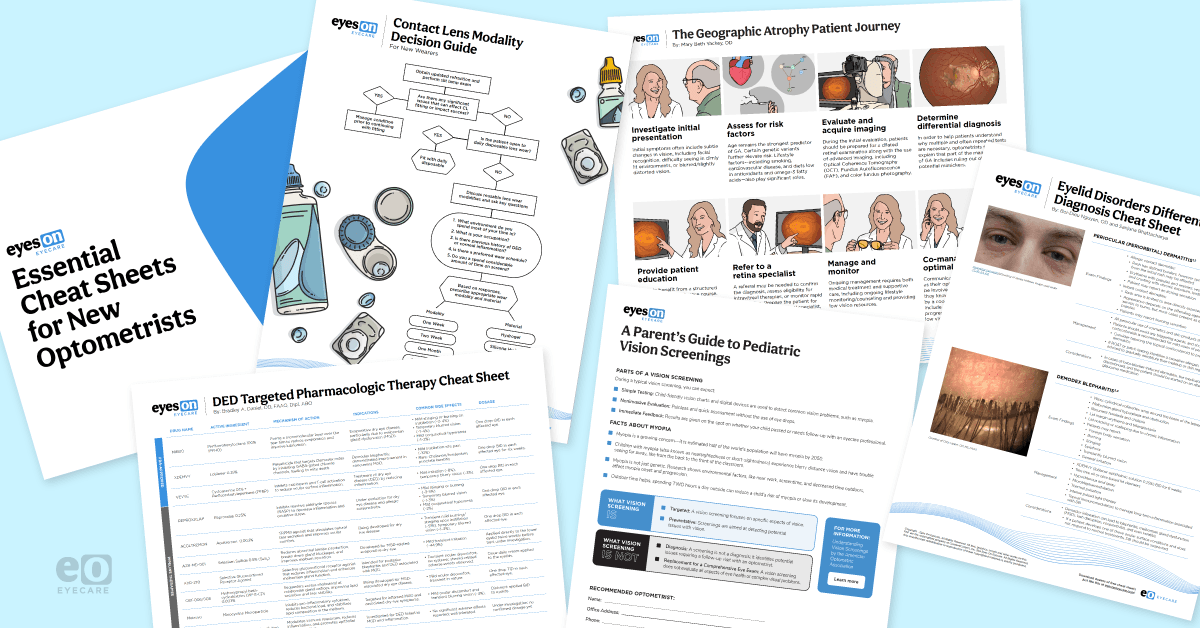
Throughout your optometric journey, you will encounter far more information than anyone could realistically remember. From pharmacology to ocular disease to coding and billing, there is an immense amount of critical clinical knowledge to master at various stages of both your academic training and your professional career.
To help simplify this process, we’ve created our most comprehensive collection of cheat sheets to ensure you have all of the most essential information at hand.
The current state of optometry
With emerging technologies, expanding treatment options, the incorporation of artificial intelligence (AI), advances in imaging, and increased collaboration with ophthalmologists, today’s clinicians are practicing in a landscape that looks very different than it did even just a decade ago.
Treatment paradigms are taking on an interventional mindset with the focus on early diagnosis and proactive therapies. Innovations—such as sustained-release glaucoma therapies, minimally invasive glaucoma surgery (MIGS), pharmaceutical and contact lens interventions for myopia, wider use of amniotic membranes, mechanism-based dry eye treatments, and individualized specialty contact lenses—are redefining clinical decision-making.
Routinely reviewing the basics and utilizing cheat sheets allows you to streamline workflows and provide more confident care.
These cheat sheets cover a range of topics, ranging from clinical to practice management, including:
- Retinal dystrophies and inherited retinal diseases
- Staging criteria and treatment guidelines for AMD
- Fundus exams for retinal pathology
- Common macula findings on OCT
- Differentiating conjunctivitis, episcleritis, and scleritis
- Differentiating eyelid disorders
- How to use vital dyes in optometry
- Reference guides for artificial tears and glaucoma medications
- Guide to selecting a contact lens modality
- Review of cranial nerves relevant to optometry
- Key considerations for optimizing binocular vision
- Grading scales for common ocular diseases
- Vertex distance conversion table
- List of targeted pharmacologic therapies for dry eye disease
- Nutraceuticals for dry eye and improving ocular health
- Essential billing and coding information for ODs
- A budgeting cheat sheet for tracking and increasing revenue at your practice
And many, many more!
Download the collection of cheat sheets here!

Essential Cheat Sheets for New Optometrists
Get over 100 pages of charts, differential diagnosis guides, tables, reference guides, imaging pearls, and more to help you stay current with clinical knowledge.

Top trends in eyecare
As patient expectations grow and treatment options multiply, clinicians must balance efficiency with evidence-based care. Over the past year, five trends have dominated the eyecare space.
1. Artificial intelligence
AI has infiltrated every aspect of eyecare from practice management to diagnosis to treatment decisions. AI tools, based on deep learning and neural network algorithms, have shown remarkable success in diagnosing, monitoring, and managing various ocular and systemic conditions.
Significant clinical applications include early detection of diabetic retinopathy, glaucoma, and age-related macular degeneration (AMD) as well as diagnosing systemic diseases based on retinal images. For cataracts, AI-powered platforms are used for surgical assistance to ensure higher accuracy and precision.1,2
In addition to the clinical aspect, AI can also be easily leveraged to streamline administrative support. Primary eyecare services can utilize these tools to reduce the dependence on administrative support staff. AI-automated software can be used for appointment scheduling, billing, and much more.
Programming the software with AI-powered algorithms to ensure accurate and error-free documentation can further enhance patient care. Natural language processing models can be used as scribes in busy clinical settings.1,3
2. Myopia management
A recent study highlighted the gradual increase in myopia prevalence from just over 24% in 1990, to an estimated ~40% come 2050—things look especially dire for adolescents, nearly half of whom will be myopic come the century’s midpoint.4 Uncorrected refractive error remains one of the leading causes of visual impairment.5
Risks associated with high myopia include retinal detachment, myopic chorioretinal neovascularization, myopic choroidopathy, early onset cataract formation, and increased incidence of glaucoma.6 These alarming statistics are prompting clinicians to adopt early assessment and aggressive evidence-based strategies to slow progression in pediatric patients.
Correcting refractive error with glasses is no longer enough. Orthokeratology and daily disposable soft contact lenses often offer better vision-related quality of life than spectacles. Studies, such as Atropine for the Treatment of Myopia (ATOM) and Low-Concentration Atropine for Myopia Progression (LAMP) and the more recent phase 3 STAR study by Sydnexis have shown the effectiveness of low-dose atropine.
Refractive surgery, which encompasses cornea-based procedures and lens-based solutions, has become an essential part of modern myopia management.7,8
3. Customized contact lenses
The US Centers for Disease Control and Prevention (CDC) states that there are roughly 45 million contact lens wearers in the US as of 2025.9 To keep up with this demand, contact lens technology is evolving with new materials, wetting agents, drug-eluting lenses, and improved specialty designs that enhance comfort and therapeutic capabilities.
Contact lenses have evolved from a solution for refractive errors to play a pivotal role in managing complex corneal conditions, ocular surface disease, and visual rehabilitation. Advances such as scleral lenses for keratoconus and severe dry eye, orthokeratology for myopia management, and customized multifocal lenses have transformed this field into a thriving specialty with both medical significance and business opportunities.
Short on time? Check out the Essential Cheat Sheets for New Optometrists!
4. Increased collaboration
The expanding role of co-management between optometrists and ophthalmologists reflects a shift from a traditional referral-based model to a more integrated, collaborative approach to patient care. While ophthalmologists continue to focus on surgical interventions, optometrists increasingly manage pre- and post-operative care, helping to streamline the surgical process and improve efficiency.
This partnership not only enhances surgical listing rates and allows ophthalmologists to prioritize complex procedures, but also supports continuity of care through shared clinical responsibilities. Optometrists now play a broader role as educators, patient advocates, and clinical collaborators, guiding individuals through decision-making and contributing to outcomes that are increasingly patient-centered.10
This evolution has been driven by advances in surgical technology and growing demand for accessible, coordinated eyecare. Co-management can improve patient access and convenience by allowing follow-up care to occur closer to home, while maintaining communication between providers to ensure consistent, high-quality outcomes.
Although outcomes are largely favorable—such as high rates of post-operative visual success and low complication rates—the expansion of optometric responsibilities, particularly in surgical privileges, still garners debate. Moving forward, the success of co-management will depend on standardized training, shared ethical responsibility, and a continued focus on delivering safe, effective, and collaborative patient care.10
5. Emphasis on ocular health
At the same time, ocular health is being recognized as an integral component of overall wellness, with optometrists playing a vital role in detecting systemic disease, managing digital eye strain, and guiding patients through the overwhelming amount of health information circulating online. Patients are beginning to comprehend the importance of regular eye exams, ocular hygiene, UV protection, and the role of nutrition and nutraceuticals.
To view the eye as a self-contained system is inherently myopic. A retinal hemorrhage may signal uncontrolled diabetes or a pale optic disc may hint at compressive pathology. Seemingly small findings can be the earliest indicators of underlying systemic pathologies. Therefore, preserving vision is as much about treating the eye as it is about supporting the body to which it belongs.
As patients more understand this connection, and interest in natural therapies continues to grow.11 As healthcare providers, lifestyle medicine is seldom emphasized in our education and, therefore, in our discussions with patients. This lack of exposure can impede a patient’s ability to adopt healthy behaviors that prevent disease.12
With the rise in popularity of social media platforms comes the ease with which health-related misinformation can spread.13 Influencers may endorse dietary supplements while withholding risk-related information that manufacturers are legally required to provide.14 As a result, it is increasingly important that eyecare professionals be equipped to address patient questions with evidence-based information.
Utilizing these cheat sheets offers an opportunity to free up time and mental energy, so you can keep up with these trends and more!
In conclusion
Ultimately, the pace of innovation in optometry shows no signs of slowing. For new grad optometrists entering this dynamic environment, staying current with clinical knowledge can feel overwhelming.
This is where concise educational tools—such as optometry clinical cheat sheets—become especially valuable. We hope these cheat sheets help you stay organized, efficient, and prepared to deliver high-quality care in an increasingly complex clinical landscape.