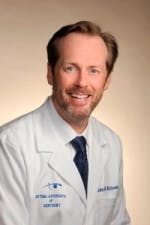
In this episode of Retina Mentor Moments, John Kitchens, MD, sits down with Jayanth Sridhar, MD, to discuss how training across institutions, and continuing to learn from colleagues and trainees afterward, helps surgeons adapt their technique and improve patient care.
“I really hope that people who get out and have great training don't do the same things the same way 20 years later.”
Dr. Sridhar is a vitreoretinal surgeon and Chief of Ophthalmology at Olive View–UCLA Medical Center. He completed residency at Bascom Palmer Eye Institute and fellowship at Wills Eye Hospital, then spent 7 years on the Bascom Palmer faculty.
Vitreoretinal surgery fast facts
- Medicare fee-for-service data from 2013 to 2021 show that pars plana vitrectomy (PPV) use for retinal detachment (RD) repair rose 21%, while scleral buckle (SB) use fell 23%. PPV was the most common RD procedure in every US region.1
- In a survey of 117 young vitreoretinal surgeons, competency required an estimated 34 SB and 91 PPV cases during fellowship. Median SB completions per fellowship year fell from 13 before COVID-19 to 3.3 during the pandemic.2
- A meta-analysis of 30 studies (1,133 eyes) found that chandelier-assisted SB achieved a pooled primary anatomic success rate of 91.7%. That rate was comparable to standard SB, and surgical time was about 19 minutes shorter.3
- An estimated 9.6 million people in the US had diabetic retinopathy in 2021, and 1.84 million had vision-threatening disease.4
- In a 2023 survey of 209 listeners of an ophthalmic education podcast, 99% said it improved their fund of knowledge.5
Value of training across multiple institutions
Residency and fellowship programs expose surgeons to different surgical philosophies, techniques, and clinical workflows. Dr. Sridhar grew up, went to medical school, and completed residency in Miami, and he planned to stay at Bascom Palmer for fellowship. His Bascom Palmer mentors, including Harry Flynn, MD, and Nina Berrocal, MD, encouraged him to train elsewhere. He now considers that decision essential to his professional growth.
He gives the same advice to residents who want to stay at their home program. Staying simplifies housing, relationships, and family logistics. However, even a program with diverse attendings shares habits, such as how buckles are placed, which bands are used, and how detachments are drained.
Dr. Sridhar explained that "every institution sort of has an undercurrent that guides even basic surgical things." Fellowship at Wills also exposed him to Mid Atlantic Retina's private practice model, which showed him how a high-volume clinic can run efficiently.
“It's great if you're the attending who operates a little differently, because you're adding more to your fellows and residents' education.”
Adapting surgical techniques
At Bascom Palmer, most attendings reserved perfluorocarbon liquid (PFCL) for severe proliferative vitreoretinopathy or giant retinal tears. At Wills, a strong cohort used PFCL as the primary drainage method for vitrectomy in primary RD. A surgeon trained at only one of those programs might consider the other approach heresy.
Outcome data suggest that both approaches reattach the retina but differ in other ways. The retrospective ELLIPSOID study included 300 macula-off RDs. Single-operation reattachment rates were similar for drainage through the peripheral break (86%), posterior retinotomy (85%), and PFCL (83%). However, in that single retrospective study PFCL-assisted drainage was associated with worse visual acuity at 1 year and more ellipsoid zone disruption (49% vs. 29% and 31%).6
Knowing more than one approach to sutures, drainage, and tools such as chandelier buckles lets surgeons tailor procedures to each patient and to the resources available. Dr. Sridhar says attendings can keep updating their technique by asking fellows and residents how other surgeons handle specific cases. "Just talk to your fellows and just start asking them," he advised.
He took that advice himself with endolaser. Most of his fellowship attendings used repeat mode. Then one of his former fellows, Sarah Read Choi, MD, pointed out that Dr. Berrocal's continuous setting produced a single tone rather than constant beeping as well as more uniform laser burn. He asked for a demonstration and now uses continuous laser for every case. For placing PRP, he fires intermittently while keeping the laser on the continuous setting.
Evolving responsibilities in podcasting
Early in his podcasting career, Dr. Sridhar says inexperience made him bold because he did not consider how many people were listening. Over time, listeners who first tuned in as medical students became practicing surgeons, and his view of the role changed. He noted that once audiences put a host on a pedestal, "everything that you say is going to carry added weight." That influence also lets a host shape practice patterns, such as encouraging a surgeon to add a buckle to a vitrectomy.
His episodes now go beyond medicine and surgery to cover US practice dynamics, insurance, step therapy, prior authorization, and ambulatory surgery center access. These barriers are measurable. One study examined 2,225 anti-VEGF prior authorization requests across nine retina practices. Although 96.2% were approved, 57.4% of patients had a delay in care, and each request took a median of 100 minutes of staff time.7
Some international listeners, who make up about 20% of his audience, have asked for fewer policy episodes.
“You cannot have a conversation in medicine about just surgery and clinical medicine without feeling like you're an ostrich with your head under the ground.”
Increasing surgical vigilance in severe diabetic retinopathy
Diabetic vitrectomy now makes up about 80% of Dr. Sridhar's surgical volume, at 30 to 40 cases per month. His approach has swung between restraint and more aggressive techniques. For example, he found that outcomes after internal limiting membrane peeling in diabetic eyes were sometimes poor. On the other hand he now stains with triamcinolone acetonide as many as four to eight times per case to reveal and peel hidden sheets of vitreous and membranes that earlier staining may miss.
He acknowledges that no evidence yet shows repeated staining changes final outcomes. Residual pathology does carry risk, though. In a 2023 study of 238 eyes that underwent vitrectomy for diabetic vitreous hemorrhage, 15.1% required revitrectomy.8
Those eyes tended to have tightly adherent fibrovascular membranes and higher HbA1c levels.8 For patients with poor HbA1c control, high blood pressure, and poor general health, Dr. Sridhar believes surgeons should do everything possible without adding operative time or ischemia.
“I would say you don't control the final outcome, but it behooves you to kind of throw the kitchen sink and do everything possible, because if you leave something, it may burn you and burn that eye.”
In closing
Dr. Sridhar's career shows that surgical technique is shaped by exposure as much as by skill. Training at more than one institution, asking fellows how other surgeons operate, and attending meetings give surgeons options when a standard approach does not fit the case.
As opportunities for SB training shrink, trainees and attendings need to seek out that exposure deliberately. For surgeons treating high-risk diabetic populations, the same principle applies in the OR: confirm that no traction remains before closing.