


Retinal vein occlusion (RVO) is a retinal vascular disorder characterized by the obstruction of retinal venous drainage by a thrombus, leading to impaired blood flow, retinal hemorrhages, edema, and variable degrees of vision loss.1 RVO is often due to a thrombus formation and may involve the central, hemi-central, or branch retinal vein.
It is the second most common retinal vascular disease after diabetic retinopathy.1 In the Beaver Dam Eye Study, the prevalence of RVO among adults aged 43 to 84 was 0.6%; this rose to 3.4% in 80- to 89-year-olds.2 BRVO is four times more common than CRVO.3
Vascular risk factors such as hypertension, diabetes, and atherosclerosis are linked to RVO. Hypertension is the most significant systemic risk factor, present in about 64% of RVO patients.4 RVO can cause vision impairment and serves as an important indicator of systemic vascular disease, emphasizing the need for interdisciplinary management and holistic patient care.
Breakdown of main RVO subtypes
RVOs are broadly categorized based on the site of obstruction—central retinal vein occlusion (CRVO), branch retinal vein occlusion (BRVO), and hemi-retinal vein occlusion (HRVO).
In CRVO, a thrombus forms within or posterior to the lamina cribrosa, affecting the entire venous drainage of the retina and causing hemorrhaging in all four quadrants.3 CRVO can be further divided into ischemic and non-ischemic types, based on perfusion on fluorescein angiography (≥10 disc diameters [DD] of non-perfusion defines ischemic CRVO). There are also other tests that can help identify ischemic versus non-ischemic, including APD and now OCT-A.
BRVO occurs when a retinal arteriole compresses an adjacent venule at an arteriovenous crossing site, most commonly in the superotemporal quadrant.3 This is because arteriovenous crossings are most abundant in this region, and the venules draining the macular area join the superotemporal vein before exiting the optic disc, making them more prone to compression.5
BRVO results in sectoral hemorrhaging and retinal edema. BRVO can be sub-classified into ischemic (≥5 DD of capillary non-perfusion) and non-ischemic (<5 DD). HRVO shares features of both CRVO and BRVO; it involves either the superior or inferior half of the retina due to occlusion of one of the two main trunk veins before they merge into the central retinal vein.
It is worth noting that CRVOs and HRVOs have clinically similar courses. They are associated with glaucoma and have a higher risk of anterior segment neovascularization and neovascular glaucoma compared to BRVO.
Figures 1, 2, and 3: Ultra-widefield imaging of CRVO, BRVO, and HRVO, respectively.

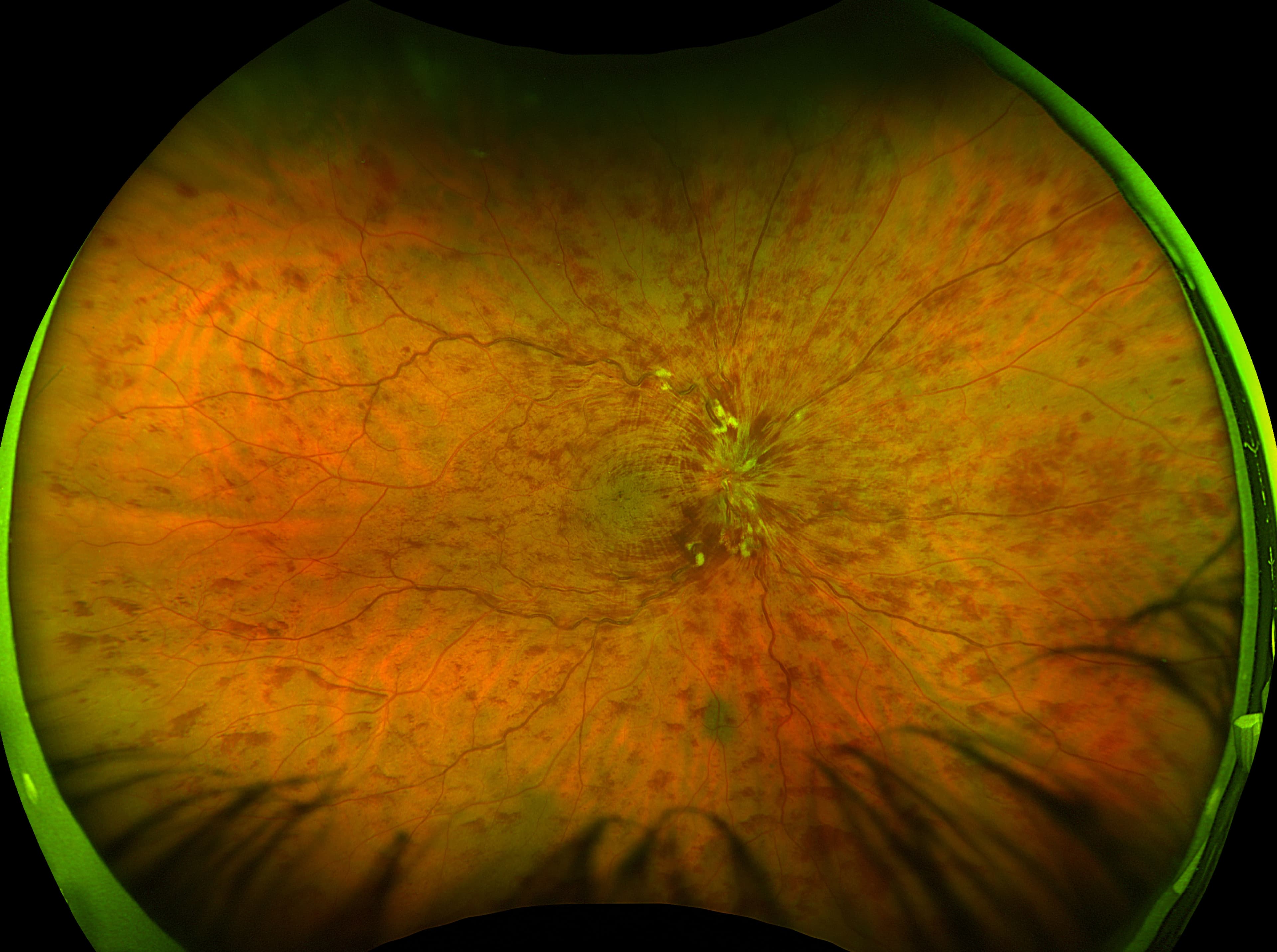
Figure 2: Courtesy of Optos.


Figure 3: Courtesy of Optos.


Figure 4: Courtesy of Optos.
Download the cheat sheet here!

Retinal Artery and Vein Occlusions Cheat Sheet
Use this cheat sheet to refresh yourself on risk factors, workup, management, and follow-up for all types of retinal vein occlusion.

Pathophysiology of retinal vein occlusion
The pathogenesis of RVO is not fully understood and is thought to be multifactorial. Virchow's triad of thrombosis—which includes venous stasis, endothelial injury, and a hypercoagulable state—plays a key role.6
In CRVO, the central retinal artery and vein share a common adventitial sheath at arteriovenous crossings posterior to the lamina cribrosa. Sclerosis of the central retinal artery can cause compression of the central vein, leading to CRVO.6
In BRVO, atherosclerotic changes at an arteriovenous crossing are seen. Thrombosis of one of the hemi-trunk veins before they converge into the central retinal vein results in HRVO.3
Obstruction of venous outflow leads to turbulent blood flow, increased venous pressure, and congestion of fragile capillary walls. These capillaries then rupture and produce the characteristic flame-shaped and dot-blot hemorrhages seen on clinical exam.3
As oxygen perfusion reduces in the retina, it becomes hypoxic and causes compromise of the inner blood-retinal barrier. Plasma and serum leak into the retina, causing retinal and macular edema.3
Vision loss in RVOs occurs due to edema and ischemia. Hypoxic conditions also stimulate the release of vascular endothelial growth factor (VEGF), which increases vascular permeability and drives the growth of new abnormal vessels in the retina, disc, iris, or angle.3 If untreated, these fragile neovascular vessels can lead to further complications such as vitreous hemorrhage or neovascular glaucoma.
Review of RVO risk factors
RVO is associated with both systemic and ocular risk factors. Due to its vascular affiliations, systemic diseases such as hypertension, hyperlipidemia, cardiovascular disease, and diabetes mellitus are common systemic risk factors.2 Hypertension is the most frequent, found in approximately 64% of RVO patients, followed by hyperlipidemia and diabetes.4
Increased age, body mass index, smoking, and past COVID infection and other blood dyscrasias, including sickle cell, also increase the risk of RVO.4,7 In younger patients, oral contraceptive use, vasculitides, such as sarcoidosis, syphilis, systemic lupus erythematosus, and hypercoagulable states such as polycythemia or multiple myeloma, may also contribute.4
Glaucoma is the most common ocular condition associated with CRVO, as elevated intraocular pressure can further impede venous outflow and contribute to recurrence.8 Optic disc drusen and small, crowded discs are also thought to be ocular risk factors.8
Clinical presentation and diagnosis of RVO
Patients with RVO typically present with sudden, painless, unilateral loss of vision, blurring, or metamorphopsia.3 In CRVO, vision loss is generally diffuse, while in BRVO it may be sectoral, corresponding to the area of occlusion.
In HRVO, vision loss is usually sectoral or altitudinal, affecting either the upper or lower visual field, depending on which hemiretinal trunk is occluded. Some patients may report distortion or scotomas, particularly if macular edema is present.3
Below is an outline of the clinical presentation of the RVO subgroups:3
CRVO:
- Presentation: Diffuse retinal hemorrhages in all four quadrants (“blood and thunder” appearance), dilated tortuous veins, cotton-wool spots, exudates, and retinal edema
- Ischemic CRVO: Profound vision loss with VA <20/200, RAPD, and extensive capillary non-perfusion (often >10 DD on fluorescein angiography)
- Non-ischemic CRVO: Vision better than 20/200, mild or no RAPD
- Edema: Macular edema is the most common cause of vision loss, occurring in approximately 75% of CRVO cases9
BRVO:
- Presentation: Hemorrhages, edema, and venous dilation confined to one retinal quadrant, most commonly superior temporally and respecting the horizontal midline
- Ischemic BRVO: ≥5 DD of non-perfusion in the affected area
- Non-ischemic BRVO: <5 DD of non-perfusion
- Macular edema occurs in up to 60% of BRVO patients, particularly when the superotemporal vein draining the macula is involved9
HRVO:
- Hemorrhaging, cotton-wool spots, and venous engorgement involving either the superior or inferior half of the retina
- Associated macular edema is frequent and often similar in severity to CRVO9
Figure 4: Fundus photography of inferior HRVO in a patient.


Figure 4: Courtesy of Mona Tariq, OD.
Later stages may involve the formation of collateral vessels, retinal or disc neovascularization (NVE or NVD), and iris or angle neovascularization (NVI/NVA).9 These fragile new vessels may rupture, leading to vitreous hemorrhage, and NVI or NVA can progress to neovascular glaucoma within 90 days, classically called “90-day glaucoma.”9
Figure 5: Slit lamp image of florid iris neovascularization secondary to ocular ischemic syndrome (OIS).

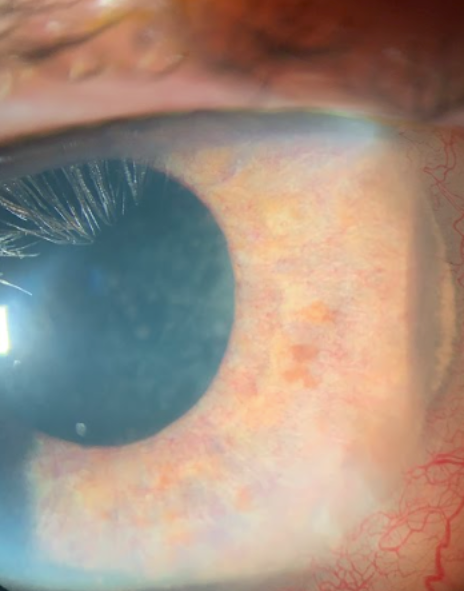
Figure 5: Courtesy of Chris Kruthoff, OD, FAAO.
Short on time? Check out the Retinal Artery and Vein Occlusions Cheat Sheet!
RVO imaging and workup
A comprehensive workup includes both systemic and ocular evaluation. The case history should emphasize cardiovascular and vascular risk assessment.
OCT and OCT-A
In addition to best-corrected visual acuity, intraocular pressure, and dilated fundus exam, OCT is essential to assess macular edema, quantify retinal thickness, and monitor treatment response to anti-VEGF.10 OCT can reveal macular edema, subretinal fluid, and disorganization of inner retinal layers in chronic cases.
Figure 6: Optical coherence tomography (OCT) of macular edema in the patient with HRVO.


Figure 6: Courtesy of Mona Tariq, OD.
In addition, OCT-A allows non-invasive visualization of the superficial and deep capillary plexus, highlighting areas of non-perfusion, neovascularization, capillary dropout, and collateral vessel formation.9 It can also show enlargement of the foveal avascular zone (FAZ) and subtle ischemic changes not visible on fluorescein angiography.9
All in all, OCT-A provides a quick, non-invasive method of identifying and monitoring ischemia as compared to fluorescein angiography.
Figure 7: A patient with central RVO: (a) Fundus photograph of RVO, (b) FA, (c) OCT-A in superficial capillary plexus, (d) cystoid macular edema is observed in OCT.


Figure 7: Central RVO©Alireza Khodabandeh et al. Image cropped and used under CC BY 4.0.
For more information on and examples of RVO on imaging, check out:
FA
Fluorescein angiography (FA) is key for assessing perfusion status and classifying occlusions as ischemic or non-ischemic.9 Areas of ≥10 DD of capillary non-perfusion in CRVO or ≥5 DD in BRVO are considered ischemic. FA also highlights areas of leakage from possible neovascularization, collateral formation, and macular involvement.9
Figure 8: Ultra-widefield FA image of CRVO.


Figure 8: Courtesy of Optos.
Visual field testing and systemic workups
Visual field testing may be particularly useful in BRVO and HRVO for correlating structure with function and ongoing screening of neovascular glaucoma.9 Gonioscopy is also valuable in monitoring for NVI/NVA and screening for neovascular glaucoma.
Systemic workup should include blood pressure measurement, fasting glucose, HbA1c, lipid profile, and complete blood count with platelets.9 In younger or atypical patients, a coagulation profile and autoimmune screening should be performed.
Management of retinal vein occlusion
Management of RVO focuses on treating macular edema, preventing complications, and addressing systemic risk factors. Optometrists should promptly refer patients to a retina specialist for co-management, as well as to the patient’s primary care physician (PCP) and/or cardiologist.
Anti-VEGF drugs
Intravitreal anti-VEGF therapy is the gold standard for RVO-related macular edema.10 Ranibizumab and aflibercept are FDA-approved and have demonstrated significant improvements in both vision and macular edema. Injections are typically dosed monthly until stability and then extended as appropriate.
Faricimab, which targets both VEGF-A and Ang-2 (angiopoietin-2, a key mediator of vascular instability and leakage), may help reduce injection frequency.10 More recently, the FDA approved aflibercept 8mg (EYLEA HD) to treat RVO based on results from the QUASAR study. The analysis found that 88% of patients sustained an 8-week dosing regimen following the required 3 monthly doses, with 93% maintaining this regimen after completing five initial monthly doses.11
Corticosteroid implants
Corticosteroid implants such as dexamethasone serve as alternatives for patients non-responsive to anti-VEGF therapy or unsuitable for it.9 However, side effects like cataract progression and steroid-induced IOP rise warrant careful monitoring.
Laser therapy
Laser photocoagulation was historically the standard for macular edema, but is now considered an adjunctive therapy. According to the BRAVO trial, grid laser may be used in BRVO with persistent edema.8 PRP is indicated for ischemic RVO with neovascularization, while PPV may be required in cases of non-clearing vitreous hemorrhage.9
Lifestyle adjustments
Systemic management is equally important—collaboration with primary care and cardiology is essential to optimize control of blood pressure, blood sugar, and cholesterol. Encouraging lifestyle changes such as smoking cessation, physical activity, diet, and weight management also supports overall cardiovascular health.12
Bolstering outcomes through patient education
Patient education is key to long-term outcomes. Patients should be educated that RVO is a vascular event and that visual prognosis depends on systemic control in addition to ocular treatment.
Visual recovery may require ongoing anti-VEGF injections, and patients must understand the importance of regular follow-ups to monitor macular edema and detect complications like neovascular glaucoma, and regular follow-ups with their PCP to optimize vascular health.
A home Amsler grid allows patients to monitor central changes. Reinforce the importance of managing underlying systemic risk factors and regular eye and physical exams, as the fellow eye carries an 8 to 10% risk of developing RVO.13
Referrals and co-management
Optometrists should refer CRVO or HRVO urgently within 1 week to a retinal specialist. BRVO with macular involvement also warrants urgent referral. The patient’s PCP should be included in the care team to optimize systemic health.
Optometrists play a key role not just in diagnosing but in monitoring and co-managing the patient with the retinal specialist and PCP. Follow-up visits should include BCVA, IOP, OCT, and DFE, with findings summarized in referral letters to the retinal specialist and PCP.
In summary, referrals for RVO are recommended based on the following clinical findings:
- Refer to retina within 1 to 2 weeks: Macular edema (any suspicion)
- Refer to retina within 24 to 48 hours: Neovascularization
Key takeaways
- RVO is the second most common retinal vascular disease after diabetic retinopathy.1
- Hypertension is the most common systemic risk factor for RVO.4
- Pathophysiology involves thrombosis, venous compression, turbulent flow, ischemia, and VEGF-driven edema and neovascularization.5
- Collaboration between optometrists, retinal specialists, and primary care providers is essential, as systemic vascular health directly impacts ocular outcomes. An eye exam often provides the first window into systemic disease.
Conclusion
RVO is a classic example of the saying “the eyes are a window to the soul”—it exemplifies the close link between ocular and systemic vascular health.
Optometrists are often the first to detect RVO, initiate diagnostic workup, and coordinate care with retinal and cardiovascular specialists.
Through prompt recognition, timely referral, and ongoing patient care, optometrists play a key role in preserving vision and systemic health in patients with RVO.

