


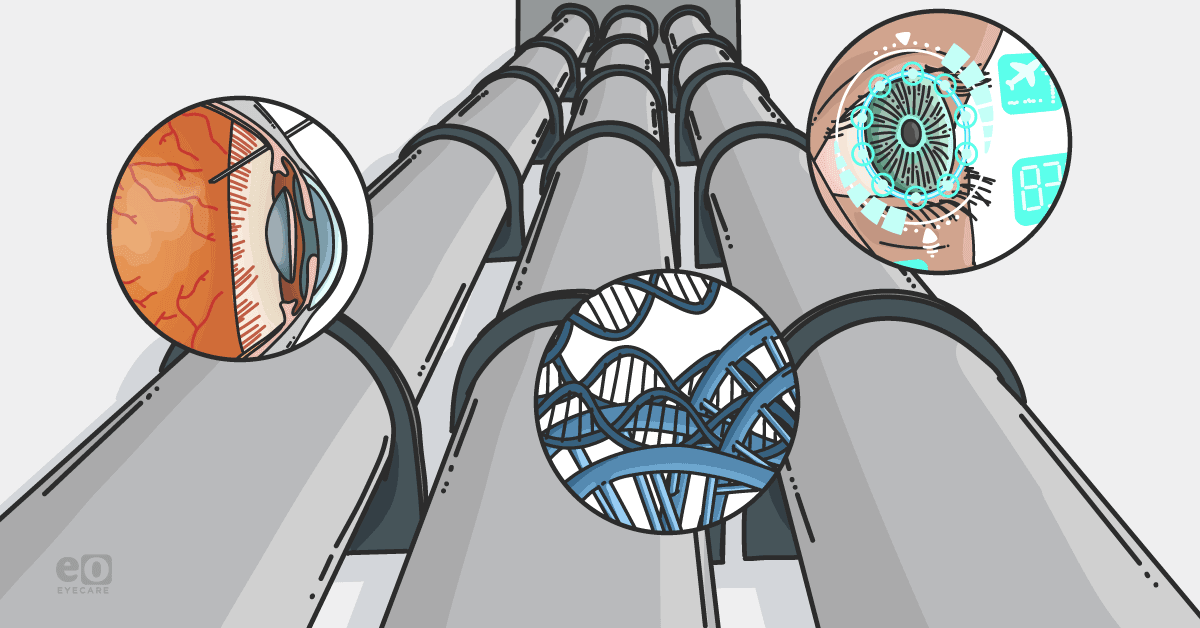
The retina clinical trial pipeline is one of the most active areas in eyecare. Demographic, biological, technological, and commercial forces have all converged to create this exciting juncture in eyecare therapeutics.
At this moment, it's important to take a step back and see how things came to be this way.
A large, chronic, and growing patient population
Retinal disease affects a large and growing population. Age-related macular degeneration (AMD) is projected to affect approximately 288 million people globally by 2040.1 Wet AMD, the neovascular form, accounts for roughly 10 to 20 % of AMD cases.2
Diabetic retinopathy (DR) affected an estimated 9.6 million Americans in 2021, with 1.84 million classified as vision-threatening, nearly double the 2004 estimate.3 Diabetic macular edema (DME) prevalence has also risen, with annual prevalence among commercially insured US adults climbing from 0.7 to 2.6% between 2009 and 2018.4
Anti-VEGF has proven that retinal disease is treatable
Before the introduction of anti-VEGF therapy, many retinal vascular conditions often resulted in progressive vision loss despite available treatments. Ranibizumab (LUCENTIS, Genentech, a member of the Roche Group), aflibercept (EYLEA, Regeneron Pharmaceuticals), and bevacizumab (AVASTIN, Genentech [used off-label in retina]) demonstrated that vision could be preserved or improved and that retinal trials could succeed both clinically and commercially.5
Anti-VEGF retinal therapies collectively generate many billions of dollars in annual revenue. Regeneron's aflibercept franchise, which includes EYLEA and EYLEA HD, generated $5.97 billion in US net sales in 2024.6 Faricimab, sold under the name VABYSMO, generated approximately $4 billion in global sales during 2024.7
Once anti-VEGF was validated, investment and research expanded into adjacent targets, including angiopoietin-2 (Ang-2), the complement cascade, tyrosine kinase inhibition, and combination biologics. Faricimab is the first bispecific antibody created for the eye. It binds to both VEGF-A and Ang-2 to stop vascular leakage and stabilize blood vessels.
The YOSEMITE and RHINE trials showed that the year 1 best-corrected visual acuity (BCVA) gains were similar to those seen with aflibercept in DME, and these gains were maintained through year 2.
The durability gap from existing injections
Despite their proven efficacy in clinical trials, real-world outcomes of injections lag substantially behind those trials. The American Academy of Ophthalmology IRIS Registry 6-year analysis of wet AMD patients reported a mean of 7.2 anti-VEGF injections in year 1, declining to 5.6 in year 2, and plateauing between 4.2 and 4.6 from year 3 onward.8
Each additional injection was associated with a 0.68 ETDRS letter improvement at year 1, and patients lost a mean of 4.6 letters from baseline by year 6.8 Treatment was discontinued in 38.8% of eyes within the study period.
This durability gap is the main driver of innovation in this field. Companies are working on longer-lasting biologics, sustained-release implants, gene therapies, and various delivery methods to reduce the injection burden many doctors and patients struggle to maintain consistently.
The eye is an ideal organ for gene therapy
The eye is an ideal organ for gene therapy due to its small target volume, a relatively immune-privileged environment supported by the blood-retinal barrier and specialized immune regulatory mechanisms.9
Voretigene neparvovec-rzyl (LUXTURNA, Spark Therapeutics) became the first FDA-approved in vivo gene therapy for an inherited retinal disease and the first directly administered gene therapy for a genetic disease approved in the United States.
LUXTURNA validated the gene therapy category. Investment subsequently expanded into wet AMD and DR programs. RegenxBio and AbbVie are jointly developing ABBV-RGX-314 in one of the largest ocular gene therapy development programs to date, with approximately 1,200 patients enrolling.10
Moreover, 4D Molecular Therapeutics is advancing 4D-150, with interim phase 2 data showing an 89% reduction in annualized anti-VEGF injection rate at 24 weeks and 77% of treated patients remaining injection-free in that window.11
To stay on top of updates in the FDA pipeline, check out the Ophthalmic Clinical Trials Tracker on Glance!
Geographic atrophy opened a new mechanistic frontier
For years, dry AMD with geographic atrophy (GA) had no approved therapy. That changed with the FDA approval of pegcetacoplan (SYFOVRE, Apellis Pharmaceuticals) in February 2023 and avacincaptad pegol (IZERVAY, Astellas Pharma) in August of the same year, both complement inhibitors that target distinct components of the complement cascade.12,13,14
The two therapies demonstrated statistically significant slowing of GA lesion growth on anatomical endpoints. Importantly, neither therapy demonstrated a clear, clinically meaningful visual acuity benefit in their pivotal phase 3 studies despite slowing lesion growth.12,13,14
Imaging, AI, and the data infrastructure underneath the boom
Retinal imaging contains a lot of data. Optical coherence tomography (OCT) uses near-infrared light, usually between 840nm spectral-domain OCT to 1,050nm swept-source OCT, to penetrate the retina and create cross-sectional images from the light that bounces back. OCT angiography (OCTA) builds on this by detecting motion contrast created by moving red blood cells. This allows for viewing the retinal microvasculature without needing to inject dye.
Medical devices provide researchers with objective, quantitative, and repeatable endpoints.15 These include retinal thickness, intra- and subretinal fluid, GA lesion area, and the structural preservation of specific layers like the retinal nerve fiber layer, ganglion cell layer, photoreceptors, and retinal pigment epithelium.
When combined with artificial intelligence applied to large, standardized imaging datasets, these endpoints speed up trial design, support risk-based follow-up, and reduce the scientific risk of late-stage failure.16
Putting it together
Retina stands at the crossroads of an aging population, chronic disease, improved imaging, gene therapy, and valuable specialty pharmaceuticals. The recent increase in pipeline activity is the result of several technological and commercial trends happening simultaneously.
For clinicians, the practical implication is that treatment options will continue to expand rapidly in terms of effectiveness, duration, and mechanisms of action. Staying up to date with comparative trial data, durability evidence, and patient preference data will become increasingly important in treatment selection.

