Myopia is no longer a future public health concern—it is a present and accelerating clinical reality. Currently, nearly 30% of the global population is myopic, and projections suggest this figure will climb to 50% by 2050, with a disproportionate rise in high myopia.1
These trends underscore the urgency of early detection and proactive myopia management, not only to optimize visual performance during childhood but also to reduce the long-term risk of sight-threatening complications such as retinal detachment, progressive maculopathy, glaucoma, and choroidal neovascularization.
As optometrists, we are now equipped with effective tools—orthokeratology (ortho-K) among them—but maximizing their clinical impact requires a deeper understanding of how small design decisions influence corneal response, visual quality, and ultimately, long-term outcomes.
Orthokeratology lens fitting and design
When selecting smaller optic zones for myopia control, clinicians should treat the optic zone diameter as a lens parameter rather than a corneal parameter. The effects of ortho-K lenses on the cornea depend on the interaction between the lens and the eye, rather than solely on the diameter of the optic zone.3,4
The first thing I want to emphasize is, don't be too obsessed with the back surface design of the lenses. While the optic zone diameter is a parameter of the lens, it's not a parameter achieved on the cornea. So instead, we should focus more on the treatment zone size achieved on the cornea after ortho-K, and treatment is stabilized.
The hydraulic pressure inducing corneal changes depends on the relative change in tear film thickness between the lens center and the area under the return zone, not on the absolute tear film thickness.5 The base curve (optic zone) and the reverse curve (return zone) are correlated factors that together cause corneal changes; they are not independent variables.3
Figure 1: Anatomy of an orthokeratology lens.


The precision of ortho-K treatment is limited by the precision of the corneal response (biological response), not the design or manufacturing precision. When measuring treatment zone size, clinicians should consistently use either the axial map or the tangential map, as comparing the two is like comparing "apples to oranges."6
For daily practice, it is important to stick with the same display and analysis method to monitor changes over time. Currently, the focus should be on identifying the corneal map or the induced corneal changes that are most beneficial for the patient's specific features, past performance, and visual demands.
Figures 2 and 3: Axial profile 180 meridian (top) and tangential map lens 3 (bottom). These images are from a lens with a 5mm back optic zone diameter (BOZD).

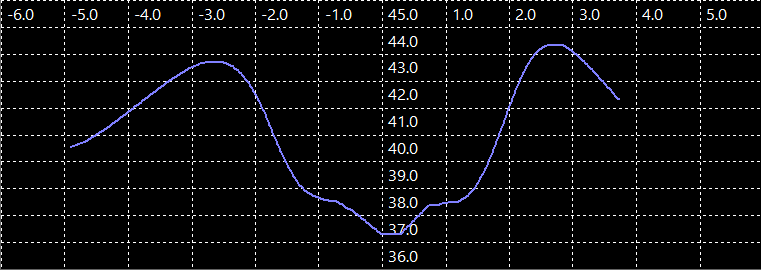

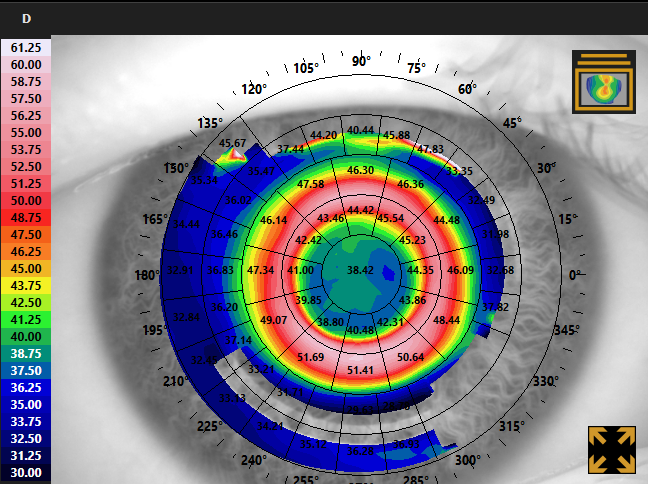
Figures 2 and 3: Courtesy of Chad Anderson, OD.
Relevance of patient-specific factors
In my research and clinical experience, there are no patient-specific factors, such as ethnicity, corneal eccentricity, corneal diameter, and corneal rigidity/viscoelasticity (measured by corneal hysteresis), that are reliable or consistent predictors of how a cornea will respond to ortho-K lenses.
Optical stop signals for myopia control should be tailored to the patient's characteristics, including:7,8
- Baseline pupil size
- Pupil angle kappa
- Pupil decentration relative to the corneal anatomical center
Patients with a very large pupil may experience greater glare, halos, and higher-order aberrations than those with a smaller pupil using the same optics.9 If the pupil sizes are large enough, the optic zone size or treatment zone size on the cornea may not matter as much in terms of the overall myopia-controlling effect.
When assessing lens decentration for myopia control effectiveness, it should be measured relative to the patient's pupil center. For long-term safety and to ensure even weight distribution, lens decentration relative to the cornea is also important.
Keep in mind, if the lens is decentered temporally in multiple patients with different types of pupil decentration, the same lens decentration does not cause the same myopia stop signal change.
Consequently, to optimize the impact of lens decentration on the efficacy of myopia control, it should be expressed relative to the patient's pupil region, since it involves a relative difference between the lens direction and the magnitude of the lens decentration relative to the pupil area.
Addressing visual acuity and aberrations
Faster onset of correction primarily benefits early visual performance and serves as a strong motivator to improve patient engagement and compliance, but it is not clinically meaningful for myopia control.
While some colleagues believe children tolerate high-order aberrations well, my experience suggests that children often don't know how to complain or express their problems verbally. Patients may report being bothered by overhead lighting during nighttime sports or feeling less confident while driving at night.
And so if we listen very carefully and try to pry for those questions or symptoms, we actually get a lot of them. So yes, it's very important to balance how much higher-order aberrations we're trying to induce with all of these myopia control optics with the quality of the patient's vision and the quality of their life. It is a tricky balance.
Clinicians must balance the induction of myopia stop signals with the patient's vision quality and overall quality of life. When patients are younger and have a higher risk of myopia progression, clinicians may be biased toward inducing more myopia stop signals, which could affect visual quality. As patients age and the risk of progression decreases, the focus should shift to the quality of their vision.
To assess for higher-order aberrations, clinicians can:
- Ask if vision stays the same in dim lighting, using a dimmer switch in the exam room to see if vision is better or worse in dimmer versus brighter light.
- Ask subjective questions, such as how their sports performance is with the lenses or if they notice any difference between indoor and outdoor vision.
Rethinking ortho-K and high myopia
It is less common nowadays to take pride in fitting high myopia with ortho-K, as other options such as multifocal soft lenses and novel spectacles provide similar or better myopia control. For patients with high myopia, ortho-K vision may decline, causing poor vision in the late afternoon or evening and reducing the effectiveness of myopia management and patient compliance.10
In my personal opinion, getting safe and effective treatment and providing stable vision for patients wearing ortho-K in the long run is a must. And if a patient's myopia is too high, that renders their ortho-K vision has too much regression–meaning the vision is decent in the morning, but as time goes by, the vision starts diminishing and ends up with a lot of residual myopia toward the end of the day.
Patients with high myopia who skip a night of lens wear may be forced to use uncomfortable lenses because their fully corrected glasses are too strong, and they cannot function without correction, significantly raising safety concerns.
They cannot achieve stable visual correction during the day, especially if they lack a good alternative to wear when they are not supposed to wear their ortho-K lenses. They are not ideal candidates and should consider soft lenses or novel spectacles.
Patient selection for ortho-K
Physical age is not the determining factor for starting ortho-K.
Three key factors for readiness include:
- The child's motivation to be glasses-free (not parents forcing them).
- The child's maturity, which means being able to verbalize problems to their parents. I have seen motivated and mature children as young as 6 to 8 years old, as well as teenagers who are unable to verbalize their problems.
- The level of engagement of parents or the family, including their willingness to supervise the daily routine of lens wear and care.
Read more on identifying children who are motivated and ready for contact lenses in the article Assessing a Pediatric Patient for Contact Lens Readiness!
Clinical practice philosophy
I encourage practitioners to understand the underlying mechanisms and design of ortho-K lenses (the "manual car" approach) rather than relying solely on automated, software-driven, or AI-supported methods (the "self-driving car" approach).
Evidence-based practice in myopia management should be effectively combined with clinical experience and an understanding of patient variability, rather than rigidly applying research evidence to each individual patient. We as practitioners do need to know the underlying mechanism of how it works, and we need to know the design of the lenses we use reasonably well, rather than giving up control and letting the manufacturers do all of the work.
Myopia management is now entering an era with many different approaches to consider. We offer a variety of optical options, including contact lenses and glasses, as well as pharmaceutical treatments. The best treatment or accommodation approach for a patient needs to be evaluated on an individual basis.11
Clinicians should be less rigid when interpreting research evidence. I have seen too many practitioners apply research findings too rigidly to each patient. For example, let’s say research says that if you start with atropine, it should be at a 0.5% concentration.
I have seen residents take patients off lower doses and switch them to higher concentrations despite no progression over the years, simply because the research suggests it. This rigid application of evidence often ignores previous treatment responses. Evidence-based practice is important, but it becomes truly meaningful only when effectively integrated with clinical experience and understanding of patient variability.
Key takeaways
- When discussing myopia control, clinicians should focus on the achieved corneal treatment zone size after ortho-K treatment is stabilized, rather than being overly concerned with the back-surface design parameter, the optic zone diameter on the lens.
- The corneal changes induced by ortho-K rely on the relative change in tear film thickness between the center of the cornea and under the return zone of the lens, not the absolute thickness of the tear film.
- The quicker onset of correction with ortho-K is seen as a significant advantage for early visual performance and for enhancing patient engagement and compliance, both crucial for treatment effectiveness.
- Clinicians need to balance the induction of higher-order aberrations from smaller treatment zones—which provide stronger myopia stop signals—with the quality of the patient's vision and life.
- Ortho-K is not suitable for patients with very high myopia due to unstable corrections and regression throughout the day. If they don't have a reliable alternative for nighttime wear, these patients should consider options like multifocal soft lenses or new spectacles.