


Contact lenses are among the most dependable recurring revenue sources in eyecare. In the US, about 45 million people wear contact lenses,1 and roughly 46% of a typical practice's patient base are contact lens wearers—with the average practice performing about 43 fits and refits per week.2
This report draws on insights from optometrists across the US and Canada, spanning new and experienced practitioners and practice owners, to capture a wide spectrum of perspectives on the current contact lens landscape—from prescribing patterns and capture rates to the gaps in education and management that represent the greatest opportunities for growth.
The 2026 Contact Lens Report covers:
- Contact lens practice and revenue
- Primary challenges and barriers of contact lenses for patients
- Most popular contact lens brands for each modality
- Confidence in fittings and specialty contact lenses
- And more!
Download the 2026 Contact Lens Report now, or read on for a preview of the findings!

2026 Contact Lens Report
Download the report to review contact lens trends, including what fellow eyecare professionals are prescribing, what patients are demanding, how ODs are improving capture rates, and the barriers and innovations ECPs are encountering in practice.

Key takeaways from the 2026 Contact Lens Report
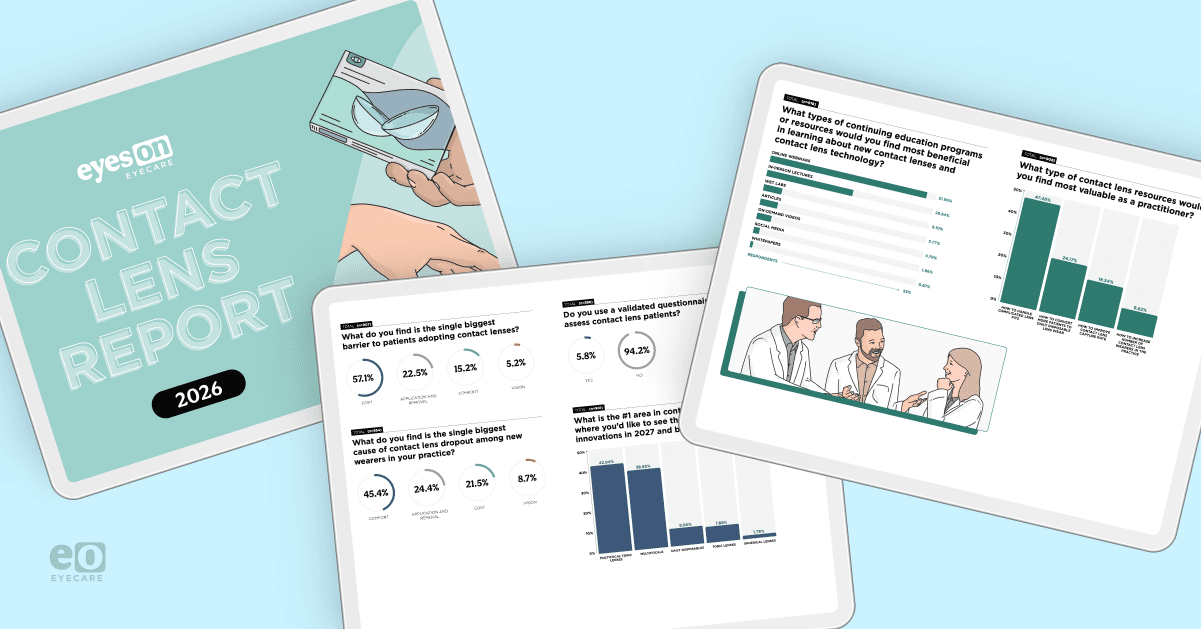
Johnson & Johnson remains the top manufacturer requested by patients, as in previous years. Additionally, most prescribers favor Johnson & Johnson products, most likely because of their confidence in achieving the best fit and the products' availability.
Doctors believe the main reason new contact lens wearers drop out in their practice is comfort, whereas in 2025, the dominant factor was cost.
Notably, cost remains the biggest obstacle to patients adopting contact lenses.
Confidence in fitting both multifocal and multifocal toric contact lens wearers has risen since 2025. Looking ahead to 2027 and beyond, the top area where doctors seek major innovations in contact lenses is in multifocals, especially multifocal toric lenses, which is consistent with 2025 sentiment.
The number of doctors using a validated questionnaire to assess contact lens patients has increased (from 0.03% to 6%).
Many participants fall into the categories of “fit occasionally” or “are interested but don’t fit” when it comes to specialty contact lenses. Interestingly, the most valued resources for doctors are those that help manage complex fits.
The top online reorder platforms practices use are ABB Optical and manufacturer direct-to-patient programs such as Alcon’s MARLO and Johnson & Johnson’s ACUVUE Shop.
In closing
We hope the 2026 Contact Lens Report serves as a practical benchmark for your practice—whether you're looking to improve capture rates, reduce comfort-driven dropout, or build confidence in specialty lens fitting.
As the contact lens landscape continues to evolve, staying current on prescribing trends, patient expectations, and emerging education opportunities is essential to growing your practice while delivering the best possible care.
Ready to dive deeper? Download the full 2026 Contact Lens Report now!
If you want more free reports like this—plus educational content and eyecare news—delivered straight to your inbox, sign up for our newsletter!

