Contact lenses correct refractive error for an estimated 140 million wearers worldwide, including roughly 45 million in the United States alone.1,2 Yet the market is nowhere near saturated.
A 2024 Contact Lens Institute (CLI) survey of more than 1,000 vision-corrected adults found that nearly 50% of spectacle-dependent patients were very interested in switching to contact lenses, and only 20% had little to no interest, meaning roughly 80% were at least moderately open to the idea.3 Despite that appetite, only about 10% of those patients had ever received a recommendation from their eyecare provider.
A patient's shot at wearing contact lenses successfully—and sticking with them—comes down to how confidently a provider can discuss material science, corneal physiology, lens design, and optics on the fly.
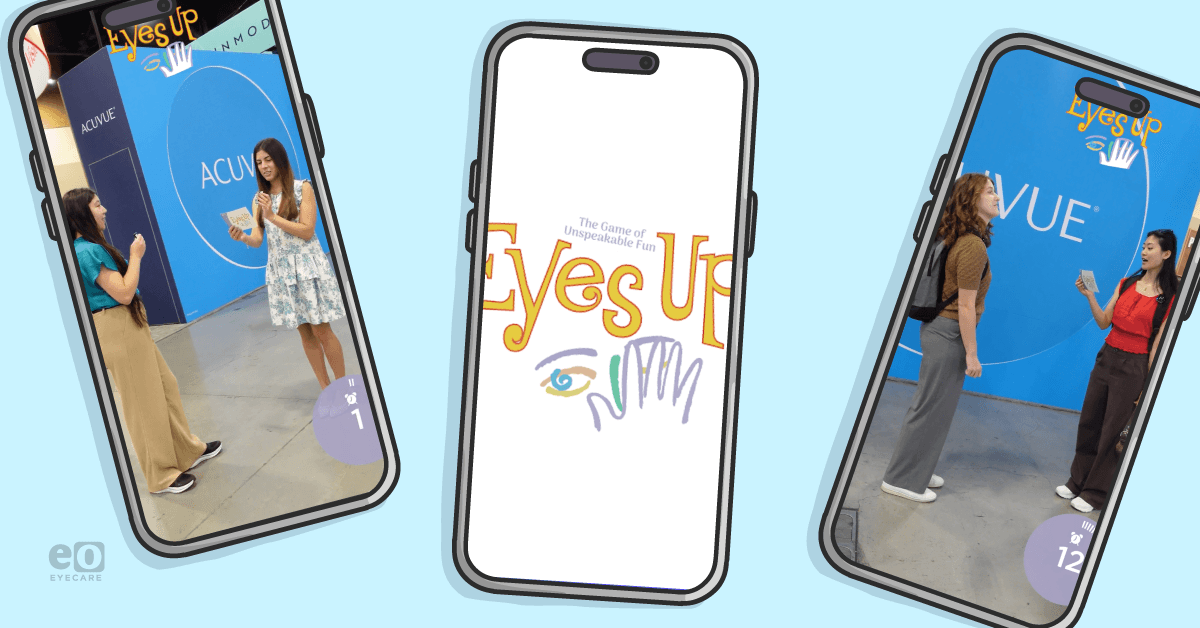
EyesUp: Contact Lens Student Edition, filmed at Optometry’s Meeting in Phoenix, takes these four key aspects and puts them in a game-show format, pairing fun and fast-paced gameplay with the clinical substance. Teams of two paired up, with one taking the role of host and the other as contestant, to test their knowledge. With only three clues and 30 seconds, see how they met the challenge.
It's all material
Silicone hydrogel hit the scene in the late 1990s and changed the comfort conversation for good, marrying silicone's oxygen permeability with hydrogel's wettability.4 Discomfort is still the number one reason patients cite for quitting contact lenses, and silicone hydrogel was engineered specifically to fight that without giving up oxygen delivery.5
A 2023 Cochrane review found the comfort and safety edge over hydrogel lenses is still backed by low-certainty evidence overall—but prescribing trends tell their own story, with silicone hydrogel steadily taking over as water content climbs and modulus drops.4,6 The material didn't just change what's in the lens. It changed how long patients stick around.
Breathe easy
Holden and Mertz set the daily wear bar for oxygen transmissibility—Dk/t—at 24, and that number still runs the show.7 Dk is the material's raw oxygen permeability; t is how thick the lens actually is at a given point. Put them together and two lenses made from the exact same material can deliver very different amounts of oxygen to the cornea, depending on design and thickness profile.
Corneal oxygenation modeling backs this up: fall short on transmissibility and the epithelium and stroma tip into anaerobic metabolism, triggering acidosis and edema.8 Dk/t is the number that actually tells you whether a lens keeps a cornea health—not whatever Dk is printed on the box.
In the blink of an eye
Old-school toric lenses lean on ballast or prism to stay put, which can quietly induce vertical prism right in the optic zone. Blink Stabilized Design flips the script, using four stability zones around the lens periphery and the eyelid's own blink to keep everything oriented.
In a study measuring vertical prism across eight commercially available soft torics, only the Blink Stabilized Design came in with virtually zero induced prism in the central 6mm zone—prism-ballast designs ranged from 0.52 to 1.15 prism diopters.9
That gap matters most for monocular astigmats, where vertical prism imbalance between eyes can trigger asthenopia. Toric prescribing has nearly doubled globally since 2000, and stabilization design is a big reason more practitioners now reach for toric lenses first instead of treating them as the backup plan.10,11
Don't be blue
Blue-violet light—roughly 380 to 450nm—scatters more than any other wavelength in the visible spectrum once it's inside the eye, which shows up as glare and softer contrast, especially on screens and behind the wheel at night.12
Lenses that filter a meaningful chunk of that range—up to 60% in the highest-filtering lens on the market today—have shown in controlled studies that they cut light scatter and glare-related visual disturbances without messing with color perception.12,13 It's a small optical tweak with an outsized effect on how patients describe their day.
In closing
Material, oxygen, design, and light aren't four separate trivia categories—they're the four variables that decide whether a patient stays in contact lenses at all. With nearly 80% of spectacle-dependent patients open to the idea and only a fraction ever hearing the pitch,3 the real opportunity isn't just fitting more patients.
It's fitting them well enough that they never think about dropping out. EyesUp: Contact Lens Edition keeps that clinical foundation sharp, one round at a time.