For more than 90 years, Topcon Healthcare has delivered innovations designed to help eye care professionals provide the highest quality care and meet the evolving needs and expectations of their patients. That commitment continues today, as clinicians face increasing pressure to manage growing patient volumes, diagnose complex diseases, and communicate clearly with patients while maintaining efficient workflows. Patients expect a seamless experience that is supported by advanced technology, straightforward explanations, and confidence in their care team. Looking ahead, the emergence of AI and oculomics (the science of leveraging ocular data to identify signs of systemic and neurological conditions) will soon place eye care professionals at the center of chronic disease management, working collaboratively with other healthcare providers.
By combining automated robotic technologies, connected cloud-based platforms, and AI-based applications, Topcon Healthcare helps practices meet these challenges with greater clinical confidence and streamlined workflows that elevate the patient experience across the continuum of care. In these modern times, patients are no longer surprised by high tech, they expect it.
As a direct sales and service organization, Topcon Healthcare supports practices throughout the entire lifecycle. From technology selection and installation to training and ongoing service, this direct model helps practices standardize operations, minimize downtime, and maintain consistent performance across locations as their clinical needs evolve.
Healthcare from the Eye™
Topcon Healthcare’s strategy for addressing the global healthcare challenges of rising costs and limited access is Healthcare from the Eye. This approach delivers oculomics through a connected care network, leveraging ocular imaging, functional assessments, and longitudinal data to identify health risks early in the disease process for both ocular and systemic conditions.
Earlier detection and the connected network enable more effective identification and management of patients with costly, chronic diseases.
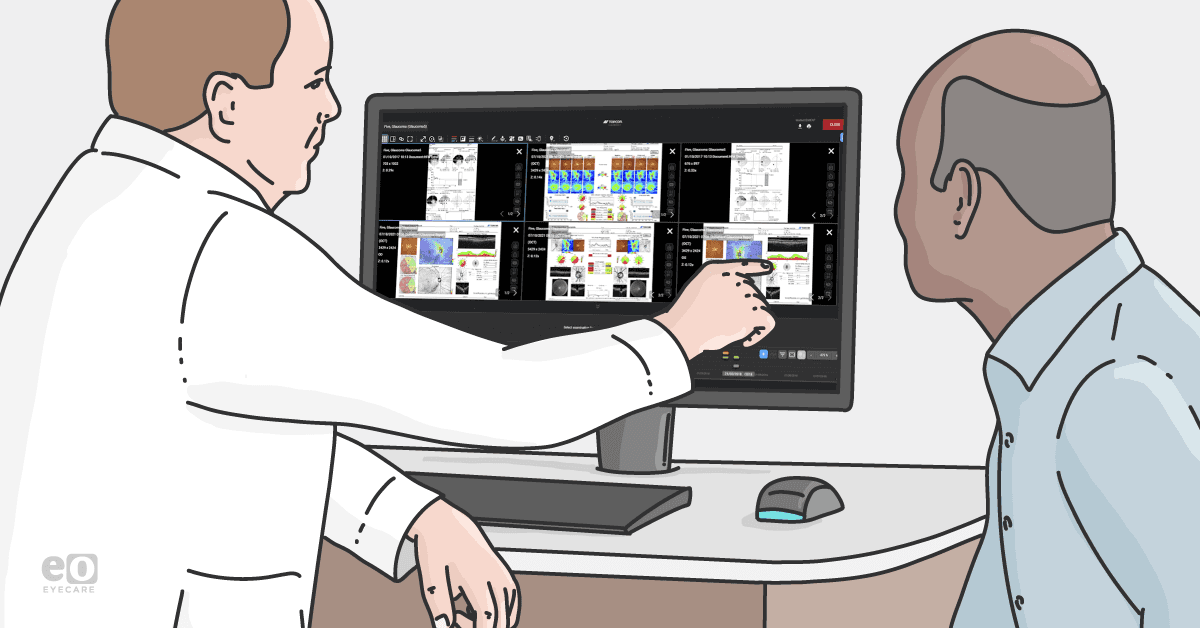
The Healthcare from the Eye network runs on Harmony®, a cloud-based, vendor-inclusive clinical data and workflow management platform that serves as the connective tissue of Topcon Healthcare’s ecosystem. Harmony centralizes multimodal imaging and clinical data in a secure, browser-based environment. Clinicians can review information remotely, customize views to match their preferences, and share insights seamlessly across providers and locations (Figure 1).


Figure 1. Harmony with Split View


From Oculomics to Real-World Impact
Building on this connected foundation, oculomics is already influencing clinical approaches to screening and disease management. Data from fundus photos and retinal OCT have been shown to correlate with cardiovascular, metabolic, and neurologic conditions. Applying proven AI models to ocular data can provide actionable insights that integrate directly into clinical decision-making. The Topcon Healthcare AI application ecosystem already includes BioAge wellness assessment and diabetic retinopathy screening. In parallel, healthcare-AI experts are developing new models for early detection of conditions such as cardiovascular disease, chronic kidney disease, Alzheimer’s disease, traumatic brain injury, and pre-eclampsia.
Dr. Kannarr notes that patient communication plays a critical role in this process.

Advancing Retina Care Through Connected and Robotic Imaging
Effective retinal disease management requires confident structural and vascular assessment, especially as incidents of diabetic retinopathy and age-related macular degeneration continue to rise. Clinicians need imaging solutions that provide comprehensive diagnostic insight while enabling efficient, repeatable workflows.
Multimodal imaging platforms, such as Maestro2 OCT® and Triton, combine true-color fundus photography, OCT, and OCT angiography together into a single workflow (Figure 2). This integration reduces patient movement between devices and shortens exam times, improving both efficiency and patient comfort. Maestro2 OCT supports automated alignment and one-touch acquisition, while Triton’s swept-source technology enables deep tissue penetration, making diagnosis possible even in challenging cases such as patients with dense cataracts.


Figure 2. OCTA acquisition using Maestro2
Understanding how disease and treatment impact vision remains central to retina care, and standardizing this functional measurement objectively is foundational to leveraging data for AI-driven clinical insights. The KR-800S captures a reproducible, objective baseline visual acuity and refraction in the workup room before the provider exam, eliminating the subjective variability inherent in manual visual acuity testing. This standardized approach ensures that vision data is comparable across visits, providers, sites, and populations. This is a critical requirement for aggregating datasets and training reliable AI models. By establishing consistent, automated measurements of where a patient's vision "starts" at each visit, the KR-800S helps practices track whether treatment is translating into functional improvement with precision.
When paired with structural findings from multimodal imaging, a complete functional-structural dataset is created that can reveal patterns invisible in either measure alone. With automated alignment, focus, and standardized data capture, the KR-800S reduces operator variability and ensures consistent measurement quality, essential advantages not only for monitoring chronic disease progression in individual patients but for building the high-quality, longitudinal datasets required to power AI algorithms and deliver scalable, data-driven insights across entire patient populations.

Fundus photography remains a cornerstone of retinal evaluation and screening. Slit scan non-mydriatic cameras, such as the NW500, are a game changer for efficient diabetic retinopathy screening and routine eye exams, as they can capture high-quality images even in patients with small pupils or media opacities. For more complex retinal cases, mydriatic systems like the TRC-50DX provide advanced imaging, including angiographic capabilities. When reviewed longitudinally within Harmony, these imaging modalities support more informed decision-making and collaborative care.
Integrating Structure, Function, and Longitudinal Insight in Glaucoma
Glaucoma management relies on the ability to detect change early and track progression confidently over time. Structural imaging, functional testing, and intraocular pressure measurements each provide important information, but their true value emerges when these data are evaluated together rather than in isolation.
Structural assessment using OCT remains foundational in glaucoma care. Imaging platforms such as Maestro2 support detailed evaluation of the retinal nerve fiber layer, ganglion cell layer, and optic nerve head. Robotic acquisition, automated alignment, and a single scan that covers all essential parameters help ensure repeatable scans across visits, minimizing variability and supporting more reliable trend analysis.
Functional testing complements these structural insights, and modern visual field solutions address workflow challenges in different ways. TEMPO™ (Figure 3), a table-top perimeter, reimagines the traditional perimetry experience by enabling faster binocular testing in ambient lighting conditions. This eliminates the need for dark room testing environments while speeding up testing time, reducing patient fatigue, and streamlining the exam process.


Figure 3. Tempo™ with Single Field Analysis
For practices seeking to expand testing capacity affordably, Inspire® offers a medical grade wearable solution that allows multiple devices to be deployed across the practice. By enabling visual field testing beyond dedicated diagnostic rooms, Inspire provides the flexibility to test patients in various locations while maintaining clinical reliability. Both solutions provide results that correlate closely with traditional perimetry, ensuring diagnostic confidence while improving patient comfort and practice efficiency.
When structural and functional findings align, clinicians gain greater diagnostic clarity in both diagnosis and treatment decisions. Synthesizing these data longitudinally is increasingly important, particularly as patients are followed over many years. Harmony brings OCT, visual fields, and ancillary data into a single, customizable view, enabling clinicians to assess progression trends quickly and consistently.

Accurate pre-test measurements, including intraocular pressure and corneal thickness, captured efficiently and objectively in the exam lane, further support this integrated approach and help guide earlier intervention.
Supporting Myopia Management Earlier in the Patient Journey
As the prevalence of myopia continues to rise worldwide, particularly among pediatric and adolescent populations, myopia management has become an increasingly important component of the comprehensive eye exam. With therapies becoming readily available and more children presenting earlier with rapid progression, early identification, treatment, and longitudinal monitoring are essential. This reality requires objective, repeatable measurements that are easy to communicate to families. Rather than relying on refractive error alone, many clinicians now emphasize axial length as a key indicator of myopia progression.
Technologies such as MYAH® support this approach by combining precise axial length measurement and corneal assessment on a single platform, making it easier to track progression over time and assess treatment effectiveness (Figure 4). Additional myopia analytics are now integrated into MYAH, elevating it to a myopia management platform.


Figure 4. MYAH® RX/AL Trends

By grounding myopia management in objective data, practices elevate both clinical outcomes and the overall patient experience while reinforcing the importance of long-term follow-up.
Reframing Dry Eye as a Lane-Based Workflow
Dry eye disease is no longer evaluated solely at the slit lamp. In modern practices, effective dry eye management begins in pre-testing, where objective data can be gathered efficiently before the clinician enters the room.
Positioned within the pre-test room, the TERA Dry Eye Imager™ allows staff to capture critical information on tear film stability and meibomian gland structure (Figure 5) early in the patient journey. Noninvasive tear breakup time and infrared meibography provide a quantifiable baseline, reframing dry eye as a measurable condition rather than a subjective complaint.


Figure 5. Meibography with TERA Dry Eye Imager

Automation and robotic alignment further support this workflow, ensuring consistent data capture while reducing technician burden.
Advancing Anterior Segment Evaluation and Patient Education
Once dry eye or ocular surface disease is identified, detailed anterior segment evaluation becomes essential. Digital-ready slit lamps such as the SL-D701, paired with the DC-4 digital camera, allow clinicians to document lid margins, tear film quality, and corneal findings with clarity and consistency (Figure 6).


Figure 6. Image captured using an SL-D701 with a DC-4 Digital Camera attachment

These imaging tools integrate seamlessly into the lane, supporting diagnosis, documentation, and education to enhance the care experience.
Cataract Evaluation and Preoperative Optimization
Successful cataract care and surgical outcomes now depend on a comprehensive understanding of the patient’s visual system, ocular surface health, and biometric accuracy, all within an efficient workflow.
During cataract evaluation, early screening measurements such as intraocular pressure and corneal thickness help inform surgical planning and risk assessment. When captured efficiently and objectively during pre-testing, a single, integrated workflow - including refractometry, keratometry, tonometry, and pachymetry - using the OMNIA, complements advanced biometry and ocular surface evaluation without adding complexity to the visit.
Additional screening tools, such as the KR-800S, Auto Kerato-Refractometer, support cataract evaluation by combining objective refractometry with glare testing and visual acuity assessment. These measurements help clinicians better understand functional vision, identify the impact of media opacity, and support conversations around surgical timing and expectations, without adding complexity to the exam.
Advanced biometry solutions such as the Aladdin Biometer remain central to cataract planning, integrating axial length, corneal measurements, anterior chamber depth, and advanced IOL calculation formulas to support a wide range of cases. With 9-in-1 exams, Aladdin is optimizing the clinical workflow for cataract patients by acquiring all necessary measurements in less than five seconds (Figure 7).


Figure 7. Cataract Workstation featuring the KR-800S and Aladdin
Equally important is information about the ocular surface. Technologies such as TERA Dry Eye Imager provide objective metrics that help clinicians identify dry eye prior to surgery, thereby improving outcomes.

The Digital Lane as the Foundation of Patient Experience
Bringing these technologies together requires a physical environment designed for efficiency and ergonomics. Digital exam lane configurations (Figure 8), customized for each practice’s needs, allow clinicians to move smoothly from screening to diagnosis to education within a single visit.


Figure 8. Exam Lane Configuration

A key element of the modern exam lane is automated refraction, where consistency and patient comfort are just as important as speed. Automated phoropters such as the CV-5000 support a more streamlined refraction experience by reducing manual adjustments and standardizing testing conditions. By automating lens changes and enabling smooth transitions between steps, clinicians can maintain focus on the patient rather than the equipment.
In some practice settings, the digital exam lane can also extend beyond the physical exam room. Remote refraction capabilities demonstrated with RDx® allow clinicians to support refraction workflows and diagnostic screening from a different location, helping practices maintain continuity of care when staffing resources are limited or care needs extend across multiple sites. By preserving the same standardized refraction experience while adding flexibility, remote refraction supports access to care without compromising clinical oversight. RDx and Harmony together provide a comprehensive tele-eyecare solution for providers and patients.
Looking Toward the Practice of the Future
Across disease states, robotics, automation, and connected data management are reshaping eye care practices. By reducing variability at the point of capture and making patient data easier to interpret and share, these technologies allow clinicians to focus less on process and more on patient care.

The common thread is integrated systems that support better decisions, more consistent care, and stronger patient relationships. Updated technology is becoming even more critical as oculomics becomes common practice and eye care professionals begin to play a greater and more integrated role in patient care.

This approach reflects Topcon Healthcare’s focus on providing technology solutions that support clinicians while keeping care human.