


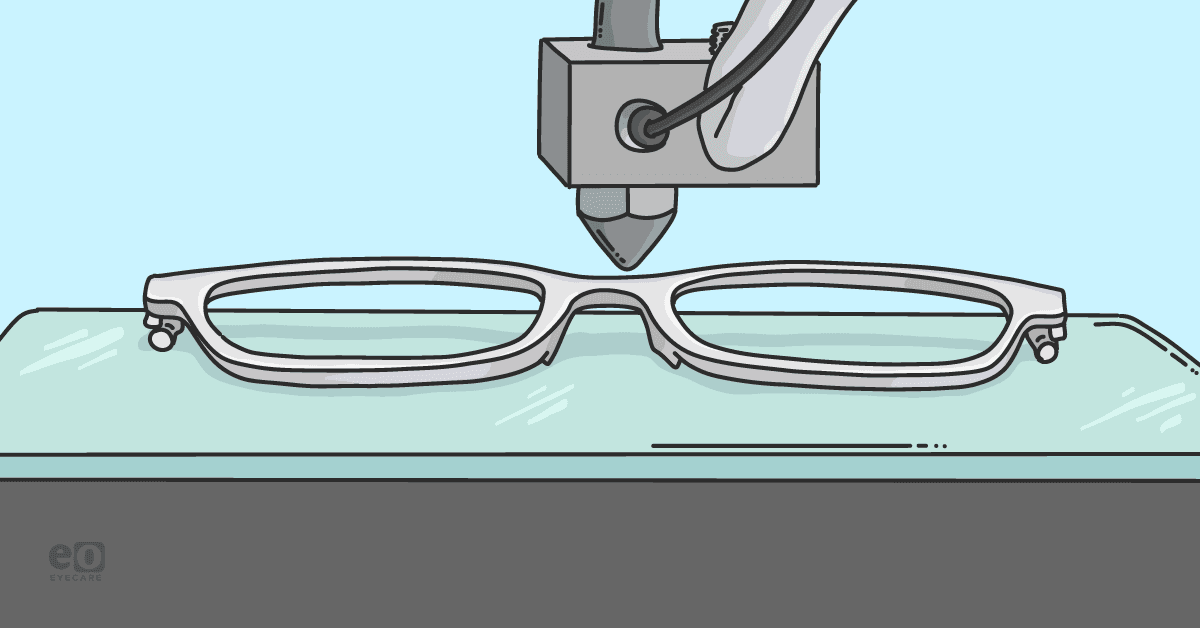
Additive technology is an exciting trend in manufacturing, commonly known as 3D printing. It has moved beyond industrial prototyping into clinical practice. In optometry, one of its most promising uses is the design and production of customized spectacle frames. Unlike mass-produced eyewear, 3D-printed glasses can be tailored to each patient’s facial anatomy and prescription needs.
The potential impact is considerable. According to the World Health Organization, at least 2.2 billion people live with vision impairment or blindness, much of which can be corrected with properly fitted eyeglasses.1 At the same time, the healthcare 3D printing market is projected to exceed $6 billion by 2030, with eyewear among the fastest-growing sectors.2
With this exciting new technology that involves digital scanning and computer-aided design (CAD), optometrists can now offer eyewear that merges clinical precision with individualized style. For patients with irregular anatomy, pediatric needs, or cosmetic requirements, this technology is a game-changer that provides solutions that conventional frames often cannot.3
A brief history of additive technology
To put it simply, 3D printing is a process that builds objects layer by layer from a digital model, minimizing waste and enabling complex designs. The technology emerged in the early 1980s when Dr. Hideo Kodama described a rapid prototyping system using photopolymers.4
In 1986, Chuck Hul built on this concept and patented stereolithography (SLA), the first commercial 3D printing method. Subsequent innovations such as fused deposition modeling (FDM) and selective laser sintering (SLS) broadened applications across plastics, resins, and metals.4
Healthcare adoption began in the 1990s with mainly dental and surgical models, expanding to prosthetics, hearing aids, and implants. Today, optometry is actively beginning to leverage additive technology to create spectacle frames, orbital implants, and anatomical models for education and surgical planning.
Table 1: List of milestones in additive technology.5
| Year | Milestone | Relevance to Optometry/Healthcare |
|---|---|---|
| 1981 | Dr. Hideo Kodama develops first rapid prototyping system in Japan | Foundation of 3D printing concept |
| 1986 | Chuck Hull patents SLA | First commercial 3D printing process |
| 1989 | FDM patented by Scott Crump | Widely used, affordable printers today |
| 1990s | Healthcare adopts 3D printing (dental implants, surgical models) | Early clinical use cases |
| 2000s | Advances in SLS and new biocompatible materials | Expanded medical and device applications |
| 2010 | 3D-printed hearing aids become mainstream | Demonstrates patient-specific device scaling |
| 2014 | First research on 3D-printed spectacle frames published | Entry into optometry field |
| 2020s | Growing commercial use of 3D-printed custom eyewear | Practical integration into optometric practice |
Table 1: Courtesy of Gao et al.
The process of 3D printing glasses
The workflow for producing 3D-printed spectacle frames can be summarized in five main steps:
Figure 1: Flowchart outlining the process of 3D printing frames.


Step 1: Capture patient data.
Firstly, a digital facial scan is performed using a handheld scanner, smartphone app, or specialized optical device. Measurements such as pupillary distance, nose bridge width, and ear positioning are recorded with precision.6
Step 2: Import data into CAD software.
The facial data is then imported into CAD software. Afterwards, the optometrist or technician designs frames that fit the patient’s unique anatomy, integrating prescription lens parameters and aesthetic preferences. Adjustments can include temple length, bridge shape, and frame thickness.
Step 3: Export the finalized design for additive manufacturing.
The finalized design is exported as a printable file (STL format). Depending on the material choice, printers may use one of the two following processes:
Fused deposition modeling (FDM)
FDM-printed frames are typically made from thermoplastics like PLA, PETG, or ABS. These materials offer good rigidity and resist everyday wear, but their durability depends heavily on the print quality, layer height, and filament type.
PLA is lightweight but less heat-resistant, while ABS and PETG provide better toughness and longevity. FDM frames can comfortably accommodate standard ophthalmic lenses if printed with precise tolerances, though they may require slight post-processing to ensure a proper fit.
Patients generally tolerate these materials well; however, rough surface finish or poorly sanded edges can cause irritation around the ears or nose. Allergic reactions are rare but may occur in individuals sensitive to certain plastics or additives.7
Figure 2: Image of a FELIX 3D printer (an FDM printer) in a typical 3D printing setup, including the printer, a MacBook running 3D printing software, and some example 3D printed objects.


Figure 2: FELIX 3D Printer©Courtesy of Jonathan Juursema. Image used under CC BY-SA 3.0.
Selective laser sintering (SLS)
SLS typically uses nylon (polyamide), a material known for its excellent strength, flexibility, and resilience. Nylon’s ability to bend without cracking makes SLS frames highly durable and suitable for holding lenses securely over time.
The material is lightweight, biocompatible, and comfortable, with a reduced risk of irritation compared to rougher FDM prints. Its longevity is comparable to conventional acetate eyewear, and hypersensitivity reactions to polyamide are extremely rare.8
The chosen material is then deposited or fused layer by layer to form the frame.
Step 4: Perform post-processing.
Printed frames undergo cleaning, smoothing, and sometimes chemical polishing. Additional coloring, coatings, or surface finishes can be applied to improve aesthetics and durability.
Step 5: Fit and dispense lenses.
Prescription lenses are edged and mounted into the custom frame. Final adjustments are made to ensure proper fit, comfort, and optical alignment.
Clinical applications of 3D printing in optometry
The clinical value and appeal of 3D printing in optometry lie in its ability to address patient-specific challenges while offering new opportunities for practice growth.
Here are a few of the unique clinical situations in which additive technologies can be useful:
- Irregular facial anatomy: Patients with craniofacial anomalies, post-trauma changes, or asymmetry may find conventional frames uncomfortable or impractical. 3D printing allows precise customization for a secure, aesthetic fit.9
- Pediatric eyewear: Children often struggle with ill-fitting frames due to smaller, changing facial proportions. Lightweight, adjustable, and colorful 3D-printed frames can improve compliance with spectacle wear.10
- Low vision and specialty aids: Custom mounts for magnifying devices or clip-on filters can be created rapidly and tailored to the patient’s needs.11
- Prosthetic and cosmetic applications: Additive technology can integrate eyewear with facial prostheses, enhancing both function and appearance in patients requiring rehabilitation.12
- Practice differentiation: Offering bespoke eyewear can set a practice apart in competitive urban markets while also appealing to patients seeking personalized care.13
Figure 3: Image of 3D printed frames.


Figure 3: 3D Printed Frames© Courtesy of Cristian Gabriel Alionte et al. Image cropped and used under CC BY 4.0.
Integrating 3D printing into practice
A series of factors will determine an optometry practice’s willingness and ability to integrate 3D printing.
It requires the following:
- Technology acquisition: Practices can either invest in in-house scanning and printing systems or partner with external 3D printing labs specializing in eyewear.
- For example, Sheinman Opticians, based in Northampton (UK), was among the first practices in the UK to adopt Hoya’s Yuniku system. According to their website, they use a 3D scan of a customer’s face to generate custom Yuniku frames.
- Also, 3DNA (based in Hong Kong) developed the 3DNA Eyewear system, which is an interactive kiosk for optical retailers/eyecare practices. The kiosk includes 3D scanning and a UI for customers and opticians to co-create custom eyewear.
- Training and workflow: Staff training in facial scanning, CAD design, and printer operation ensures smooth implementation. A dedicated technician or optician can manage this process.
- Collaboration: Optometrists may collaborate with engineers, designers, or specialized eyewear startups to leverage external expertise.
- Marketing and patient education: Highlighting the benefits of custom eyewear, like comfort, style, and sustainability, can attract patients interested in innovation.
For many practices, the most efficient entry point is beginning with outsourced 3D printing services, which minimizes investment risk while allowing optometrists to gauge patient interest before committing to in-house systems.
Companies providing 3D printing technology
There are emerging companies and specific 3D-printing setups that optometrists are using today to do custom, 3D-printed eyewear, such as:
- Materialise / Yuniku: Materialise has a workflow for 3D-printed eyewear combining face scanning, design, and printing.
- In the Yuniku system, users are face-scanned, lens position is defined, and then the frame is custom-designed and printed.
- EOS: EOS (a major 3D printing manufacturer) has a case study for You Mawo, making custom eyeglass frames using their EOS P 396 printer and PA 2200 material.
- Another case: Raytech / Hoet produced titanium frames using EOS’ metal 3D printers.
- Mister Spex: European optician chain “Mister Spex” launched a 3D-printed custom eyewear collection called EyeD, using 3D scans and in-house printing to deliver made-to-measure frames.
- GENERA / Mission Eyewear: GENERA produces a desktop/small-shop 3D system (DLP) comprising their G1/F1 printer and specific resin ("Digital Acetate") made for eyewear.
- Their Mission Eyewear brand is designed to be printed on demand in optical stores.
- Altera / Sisma / Metal Eyewear: Brand Altera has a “Stealth” eyewear collection made via metal additive manufacturing (titanium) using Sisma’s MySint platform
Billing and insurance considerations
In the US, spectacle frames are typically billed under vision plan allowances, not standard medical insurance.14 Vision frames use HCPCS V-codes (e.g., V2020 for standard frames and V2025 for frame overages), and payers generally do not distinguish 3D-printed frames via separate procedure codes.15
Consequently, reimbursement usually falls under existing standard frame categories, and any cost above the frame allowance is paid out-of-pocket by the patient.15 This presents the opportunity to position frames as premium, emphasizing customization. Meanwhile, the challenge is that there are currently no dedicated codes for “custom medical devices” in eyewear.
In Europe, reimbursement frameworks for patient-specific 3D-printed medical devices remain inconsistent, and many payers treat 3D-printed devices similarly to traditionally manufactured ones rather than creating distinct categories.16
In lower- and middle-income regions, 3D printing has enabled lower-cost local production of prosthetics, though coverage is often reliant on private payment or NGO support.17 Currently, practices should present 3D-printed frames as cash-pay or premium upgrades, while monitoring evolving coverage.
Pros and cons of 3D-printed glasses
There are a variety of advantages and challenges associated with additive technology, which should be carefully considered.
Pros:
- Customization for anatomy, prescription, and style
- Improved comfort and compliance, especially in children
- Reduced material waste
- Faster turnaround than supply chains
- Innovative designs, lightweight frames
- Potentially more sustainable materials
Cons:
- Some materials are less durable than acetate or metal
- High upfront investment in scanners and printers
- Staff training in CAD and printer use is required
- Limited regulatory guidelines
- Insurance reimbursement unclear
- Post-processing adds labor
Final thoughts
Additive technology reflects a shift in general consumer culture that tends toward personalized, patient-centered care. This trend is still emerging and yet to receive global acceptance; progress in materials and regulatory frameworks is likely to accelerate adoption.
For optometry, embracing 3D printing is leading at the intersection of healthcare and innovation, ensuring care that is both precise and personally meaningful.

