The incidence of retinal vein occlusion (RVO) in the United States is believed to be approximately 180,000 eyes per year. RVO represents a common but heterogeneous group of retinal disorders in which the hallmark pathology involves compression of a retinal vein.
These conditions can be further subdivided by anatomy into:
- Branch RVO (BRVO): An occlusion in just one segment of a retinal vein
- Central RVO (CRVO): Involves the entire retina
- Hemi-RVO (HRVO): Affects about half of the retina either superiorly or inferiorly
BRVO represents the majority of these presentations seen clinically (about 80%), and is typically encountered in older people aged 65 or above.1 Risk factors can include such comorbidities as smoking, diabetes, hypertension, hyperlipidemia, atherosclerosis, and even glaucoma.2
Pathophysiology of RVO
The underlying pathophysiology of this condition is believed to involve compression of the retinal vein by the adjacent or overlying retinal artery.
In the retina, venous compression leads to turbulent blood flow and the potential formation of thrombi, resulting in subsequent retinal ischemia and hypoxia, increased production of vascular endothelial growth factor (VEGF), enhanced capillary permeability and leakage, and ultimately, retinal edema.
Prolonged ischemia can further damage the retinal ganglion cells, leading to pigmentary degeneration and epiretinal membrane formation. Moreover, substantial retinal capillary nonperfusion often results in neovascularization of the retina and/or iris and angle, increasing the potential for irreversible vision loss.3


Clinical diagnosis and imaging of RVO
The clinical appearance of RVO is typically straightforward, presenting classically with deep and superficial retinal hemorrhages, edema, cotton-wool spots, venous dilation, and tortuosity in one to four retinal quadrants, depending upon the subtype.
Figures 2, 3, and 4: Ultra-widefield imaging of CRVO, BRVO, and HRVO, respectively.

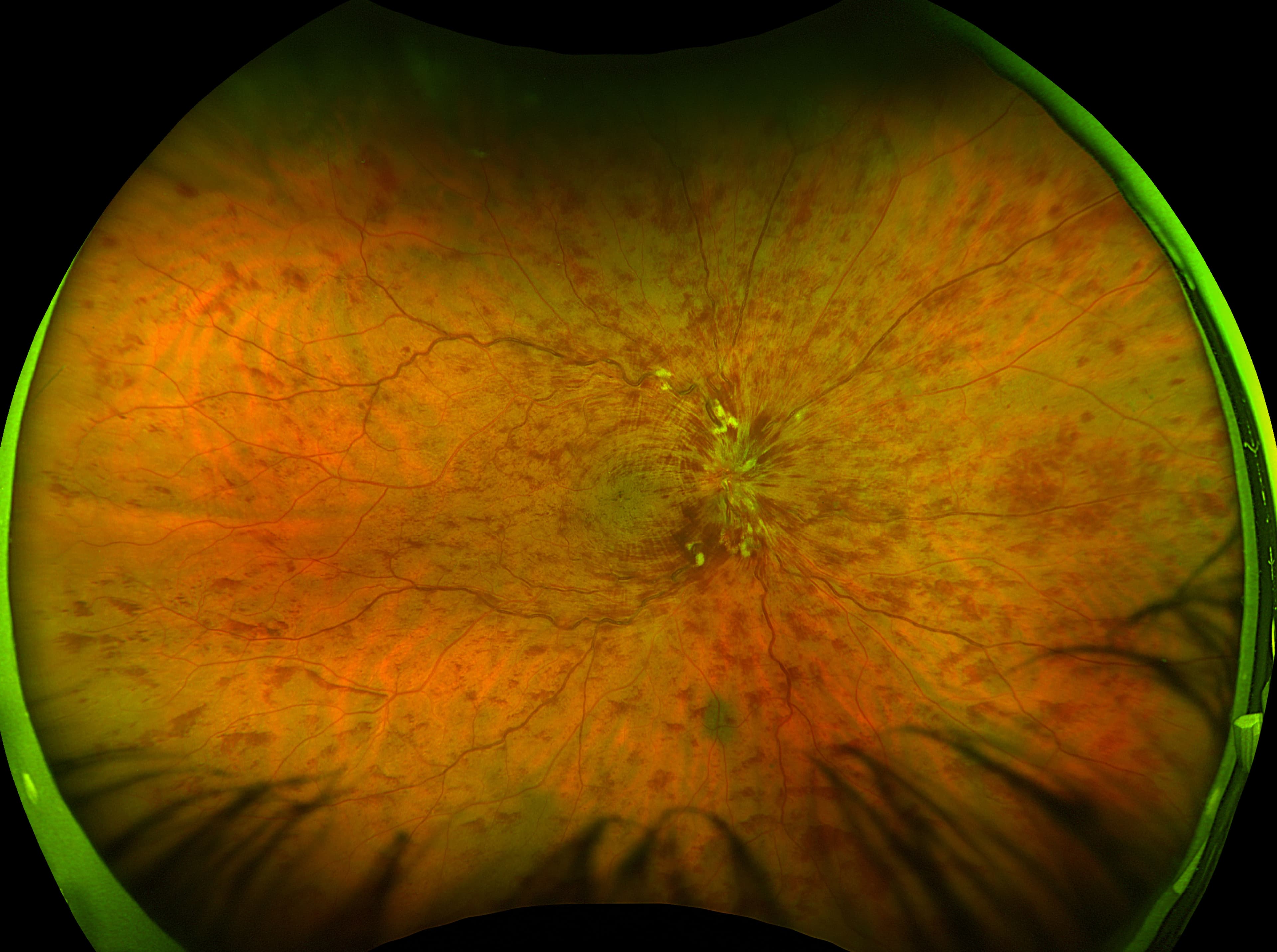
Figure 2: Courtesy of Optos.


Figure 3: Courtesy of Optos.


Figure 4: Courtesy of Optos.
Late features can include hard exudates, microaneurysms, venous sclerosis, vascular shunts at the optic disc, narrowing and sheathing of the artery, vitreous hemorrhage, tractional retinal detachment, and neovascularization of the retina, optic disc, or iris.4
Fluorescein angiography
Fluorescein angiography (FA) may help confirm the diagnosis of RVO and, more importantly, differentiate ischemic from nonischemic presentations. In cases of BRVO, FA helps to characterize the retinal vasculature as well as the extent of nonperfusion, macular ischemia, macular edema (ME), and leakage.
In CRVO, FA tends to show delayed arm-to-retina time, prolonged arteriovenous transit time (i.e., >20s), late staining along the large retinal veins, capillary dropout, and late leakage often in a petaloid pattern denoting ME.
Figure 5: Ultra-widefield FA image of CRVO.


Figure 5: Courtesy of Optos.
It is understood that in any form of RVO, the most significant concern is the degree of capillary nonperfusion; eyes with >10-disc areas of retinal capillary nonperfusion are recognized as ischemic and are prone to increased risk of neovascularization, along with its subsequent associated complications.5
Ultra-widefield FA should be conducted preferentially whenever possible, since capillary nonperfusion is most likely to occur in the peripheral areas of the retina.6
Optical coherence tomography
Optical coherence tomography (OCT) is a rapid, noninvasive imaging technique that may be beneficial in assessing, quantifying, and monitoring ME associated with RVO. Other characteristic findings may include hyperreflectivity from intraretinal hemorrhages and occasionally subretinal fluid.
Figure 6: OCT image of CRVO.


Figure 6: Courtesy of Optos.
Additionally, OCT may help to demonstrate any epiretinal membrane or vitreomacular traction that can be associated with these events. Disruption or absence of the ellipsoid zone (i.e., the high reflectance band which denotes the junction between the inner and outer segments of photoreceptors) after ME resolution is an indication of photoreceptor cell death, and this has prognostic significance for potential recovery of visual acuity.7
Management of retinal vein occlusion
Most conventional therapy for RVO is aimed at reducing the amount of ME, which serves to disrupt vision. Grid laser photocoagulation was once considered the gold standard for this complication; it was hypothesized to increase oxygen diffusion from the choriocapillaris into the inner retina, leading to autoregulatory vasoconstriction and reduced leakage.8
Unfortunately, while grid laser treatment may help slow macular leakage angiographically, its benefit on subsequent visual acuity was found to be questionable, and since the advent of intravitreal therapy, it is no longer recommended for ME.9
Intravitreal corticosteroids
Steroids have been utilized for more than 25 years in the management of retinal conditions that present with ME. The SCORE trials evaluated the safety and efficacy of intravitreal triamcinolone in eyes with ME due to RVO.10,11
While there was no difference in visual improvement between the triamcinolone and grid laser groups in the BRVO study, a significant improvement in vision was observed compared with observation alone in the CRVO study.
Unfortunately, both studies also reported a significantly increased rate of intraocular pressure (IOP) elevation and cataract formation with triamcinolone, particularly at higher doses.
For these reasons, intravitreal triamcinolone was and is not advised as a first-line treatment for RVO, but rather as a second-line agent in eyes where anti-VEGF is contraindicated or has resulted in a suboptimal response.4
Intravitreal corticosteroid implants
An intravitreal implant containing dexamethasone was evaluated in the GENEVA study for ME due to CRVO and BRVO.12 GENEVA was a 6-month study with 6 months of follow-up, comparing the dexamethasone implant to sham therapy with regard to visual recovery and central retinal thickness as measured by OCT, both of which showed improvements.
The treatment group also demonstrated higher rates of adverse events than the sham group, including eye pain, anterior chamber cells, and ocular hypertension. Fortunately, IOP elevation with the dexamethasone implant was typically transient, and nearly all cases were managed with observation or topical medications alone in the study.12
Anti-VEGF agents
In addition to corticosteroids, one of the first intravitreal therapies investigated for RVO was the anti-VEGF drug ranibizumab. This monoclonal antibody fragment targets the abnormal growth of blood vessels in the retina. The BRAVO and CRUISE studies were investigational trials of ranibizumab conducted in patients with BRVO and CRVO, respectively.13-15
These studies demonstrated conclusively that individuals treated with monthly ranibizumab injections showed significant visual improvements compared to the natural history of the disease.13 Perhaps more importantly, those in the sham treatment group who crossed over to monthly ranibizumab injections after 6 months also made significant improvements in vision.
However, they never achieved the level of improvement as did those in the ranibizumab cohort from the beginning.15 Results underscore the need for early intervention with anti-VEGF therapy in cases of RVO.
Similar outcomes were observed in later studies (i.e., VIBRANT and COPERNICUS) involving the compound aflibercept. This dimeric glycoprotein acts as a soluble protein decoy for VEGF receptors on retinal endothelial cells.16-20 Current studies (QUASAR) seek to evaluate the use of higher doses of aflibercept in an effort to extend treatment intervals.
New anti-VEGF drugs
In recent years, newer and more potent anti-VEGF agents have entered the market, offering potential for enhanced treatment options and extending the time between intravitreal injections.
Faricimab is a humanized monoclonal antibody that binds and neutralizes not only VEGF but also angiopoietic-2, a factor that is similarly elevated in patients with RVO. In the COMINO trial of treatment-naive eyes with focal center-involved ME due to CRVO, faricimab was found to be noninferior in terms of BCVA gain vs. aflibercept.21
Additionally, a greater proportion of patients in the faricimab arm achieved an absence of FA-based macular leakage compared to those in the aflibercept arm, with a similar incidence of ocular adverse events.21 Several biosimilar agents have also been approved for this use in the United States recently, including ranibizumab-nuna, ranibizumab-eqrn, aflibercept-ayyh, aflibercept-yszy, and aflibercept-jbvf.
Combination therapy for RVO
Given that intravitreal corticosteroids and anti-VEGF agents are both efficacious in managing RVO, it is natural to wonder whether their concomitant use might be of additional benefit in the long term.
Singer et al. conducted a study of 62 eyes in which patients who were already receiving bevacizumab, ranibizumab, or aflibercept intravitreal therapy underwent surgical introduction of a dexamethasone implant.22 The primary outcome was time to retreatment, while secondary outcomes included macular thickness and visual acuity, along with safety outcomes.
Overall, this study showed that those treated with this combination therapy were able to achieve a notable improvement in visual acuity, along with a diminished thickness in the central field on OCT. The effects were highly predictable, and the duration of impact between treatments was roughly 4 months.22
In terms of safety, there was a 59% incidence of cataracts requiring surgery, and 45% of patients displayed an IOP in excess of 23mmHg. However, most of the IOP elevation occurred within the first 3 cycles (12 months) of treatment, and all were managed successfully with topical therapy.22
Pipeline therapy
While several treatments are currently being investigated for the treatment of RVO, one that warrants mention is ANXV.
According to Annexin Pharmaceuticals (Stockholm, Sweden), ANXV is an investigational new drug that contains the human protein Annexin A5, produced by recombinant techniques in E. coli. ANXV has the capacity to protect cells, reduce adhesive properties, and influence immune cell activity, with a mechanism of action that involves the blocking of phosphatidylserine.
In patients with RVO, aberrantly externalized phosphatidylserine on erythrocytes is believed to be partly responsible for the pathogenic adherence of erythrocytes to endothelium, and this enhanced aggregation capacity likely contributes to the onset of RVO by predisposing to circulatory stasis and/or thrombus formation.23
If approved, some believe that this may represent a paradigm shift in the treatment of retinal vascular disorders.


Do you think our understanding of RVO has evolved significantly over the past 5 years?
Unfortunately, I believe that our understanding and management strategy are still relatively rudimentary. One crucial problem is that we don't fully appreciate the inflammatory nature of RVO, and we tend to delay initiating steroids, which might actually benefit these patients who typically become less compliant over time.
We hope that with newer medications like faricimab and high-dose aflibercept, we may be able to increase the duration between injections and hopefully reach a treat and extend paradigm, which is similar to what we're doing with AMD and DME.
What do you feel are the most significant challenges in dealing with RVO, either in terms of diagnosis or treatment?
I think our most significant issue is one of patient adherence. While we know that our medications work, and which ones seem to work best, we are inherently dealing with a working-age population of individuals who have primarily commercial insurance.
This results in two potential problems:
- Patients who need to return for careful follow-up and regular treatment tend to become non-compliant over time due to work and other personal commitments—and, unfortunately, when these medications begin to wane, they do so in a very rapid and significant fashion.
- Additionally, having 3rd party insurers in the mix means that we are often hindered by step therapy, leading to further delay in obtaining and using our preferred treatment options as early as we might like.
What pearls might you offer for young ophthalmologists in terms of making the proper diagnosis and managing RVO effectively?
Obviously, making the diagnosis and initiating therapy as early as possible is critical to successful management. One of the things that we sometimes overlook is obtaining early FA on these patients. I think that widefield angiography is particularly valuable in patients with CRVO, as it can help identify those individuals at the highest risk for complications and vision loss associated with retinal ischemia.
Similarly, I feel that we can still gain some benefit from laser treatment, perhaps not so much for decreasing ME as for reducing the chance of progression to ischemic RVO and neovascularization, based on studies involving diabetic ME.24
I would tell my younger colleagues, “Don't be scared to do laser prophylactically, because I think in the long term it may help you. Treat the areas of ischemia and go into a little bit of the perfused retina, and that may actually decrease your chances of running into problems, particularly if the patient becomes non-compliant.”
Finally, while anti-VEGF therapies are the standard of care, don’t overlook the potential benefit of intravitreal corticosteroids as an adjunctive therapy for patients who need additional intervention.
Key takeaways
- Early diagnosis and intervention are crucial for achieving the best outcomes when managing RVO. Delays exceeding 6 months can be extremely detrimental to the prognosis.
- Current anti-VEGF therapies yield good outcomes, albeit with some inherent differences in efficacy that depend on the specific drug and dosing frequency. Nonetheless, persistence of ME leads to poor outcomes after 3 months.
- Combination therapy with anti-VEGF agents and intravitreal dexamethasone increases both the duration and predictability of effect, and also likely results in better visual outcomes.
- Patient compliance with follow-up is also crucial, as deviation from regular treatment with anti-VEGF drugs can result in precipitous and dramatic changes to vision with increased likelihood of sequelae. Stress the importance of continued compliance to all patients undergoing therapy for RVO.
- Newer, currently experimental therapies, such as ANXV, may represent the next paradigm shift in the management of RVO.